

Choose a Conductive Plastics Supplier by checking five factors: material compliance, process capability, quality control, supply chain stability, and total cost. Start with your application specifications. Your device's resistivity and shielding requirements decide the compound you need. A wrong choice can cause conductivity failures, EMI shielding gaps, compliance rejections, or production delays. Every failure leads to rework, recall, or lost customer trust. This guide gives clear, ordered due-diligence steps you can use now. You will judge each supplier against your design, not against marketing claims. Start with your specification sheet, then check every claim with evidence. The steps build on each other, so follow them in order.
Key Takeaways
Set your device's resistivity target first. Choose ESD protection or EMI shielding. Use test reports early to filter suppliers.
A good supplier shows that every batch is the same. They use statistical process control. Ask for a certificate of analysis for each lot.
Think about the full cost, not just the price per part. Add in scrap, shipping, tooling, and fixing problems. A steady supply keeps your production line safe.
Test with your real design first. Measure resistivity on molded parts. Check shielding and mechanical performance.
Rate suppliers on performance, quality, delivery, cost, and support. Put quality agreements in writing. Pick a partner who values documentation.
Define Application Requirements and Compliance Standards
Before you compare suppliers, figure out what your application needs for electrical performance. You must decide if the part needs ESD protection or EMI/RFI shielding. ESD materials let static charges drain away slowly. EMI shielding materials block or bounce back interference. Each job needs its own resistivity range.
Material Category | Surface Resistivity (Ω/sq) | Volume Resistivity (Ω-cm) |
|---|---|---|
Conductive | < 1 × 10^5 | < 1 × 10^4 |
Static Dissipative | ≥ 1 × 10^5 and < 1 × 10^12 | ≥ 1 × 10^4 and < 1 × 10^11 |
Anti-Static | 10^10 to 10^12 | — |
Insulative | ≥ 1 × 10^12 | ≥ 1 × 10^11 |
Use your target resistivity to narrow down your choices. Conductive materials help with grounding and removing charges fast. Static dissipative materials protect sensitive electronics by controlling discharge. Volume resistivity shows how evenly the conductive filler spreads through the polymer matrix.
Specify Conductivity, Mechanical, and Thermal Needs
Conductive plastics get their conductivity from fillers. Common choices include carbon black, carbon fiber, nickel-coated graphite, stainless steel fibers, carbon nanotubes, and graphene. The filler type and how much you use change conductivity, mechanical properties, and cost.
Filler family | Conductivity effect | Mechanical effect |
|---|---|---|
Carbon-based | Low-to-medium conductivity, typically above 10^2 Ω/sq; EMI shielding below 40 dB | Cost-effective and processable, but particles can migrate and affect properties |
Metal-filled | Can reach below 1 Ω/sq; EMI shielding above 60 dB possible | Better strength retention, but density increases and processing is harder |
Write down mechanical strength, thermal range, and processing method. Ask for tensile strength, flexural modulus, and impact resistance. If the part makes heat, ask for thermal conductivity values. Injection molding and extrusion create different shear conditions. Conductivity can change with flow pattern and measurement direction in molded parts. Extrusion-grade compounds need high tensile elongation. Many conductive plastics work for injection molding only.
Confirm Certifications and Test Standards
Ask for up-to-date test reports for ASTM D257, ASTM D991, UL 94 flammability, and IPC/ESD standards. These reports must cover your production material, not just a lab sample.
For environmental compliance, ask for RoHS and REACH documentation. RoHS requires a compliance statement confirming that materials meet restricted concentration limits under Directive 2011/65/EU. REACH requires Safety Data Sheets, exposure scenarios, and registration dossiers. A reliable supplier gives you independent certification, conformity declarations, internal and third-party test results, and compliance statements from material suppliers.
When you choose a conductive plastics supplier, use this paperwork as your first filter. This evidence gives you a solid basis to choose a conductive plastics supplier with confidence.
Evaluate Material Portfolio and Quality Control

A supplier's material portfolio shows if they can really meet your requirements. You need compounds matched to your resin base. Common resin bases include PC, ABS, nylon, PBT, and PPS. Each resin has different thermal and mechanical behavior. Ask for published data on every grade they offer.
Review Conductive Compounds and Filler Options
Your resin choice sets the base thermal conductivity. Polycarbonate has 0.19–0.22 W/m·K. Nylon has 0.26 W/m·K. PBT and POM both reach 0.29 W/m·K. PPS hits 0.3 W/m·K. These base values matter when your device produces heat.
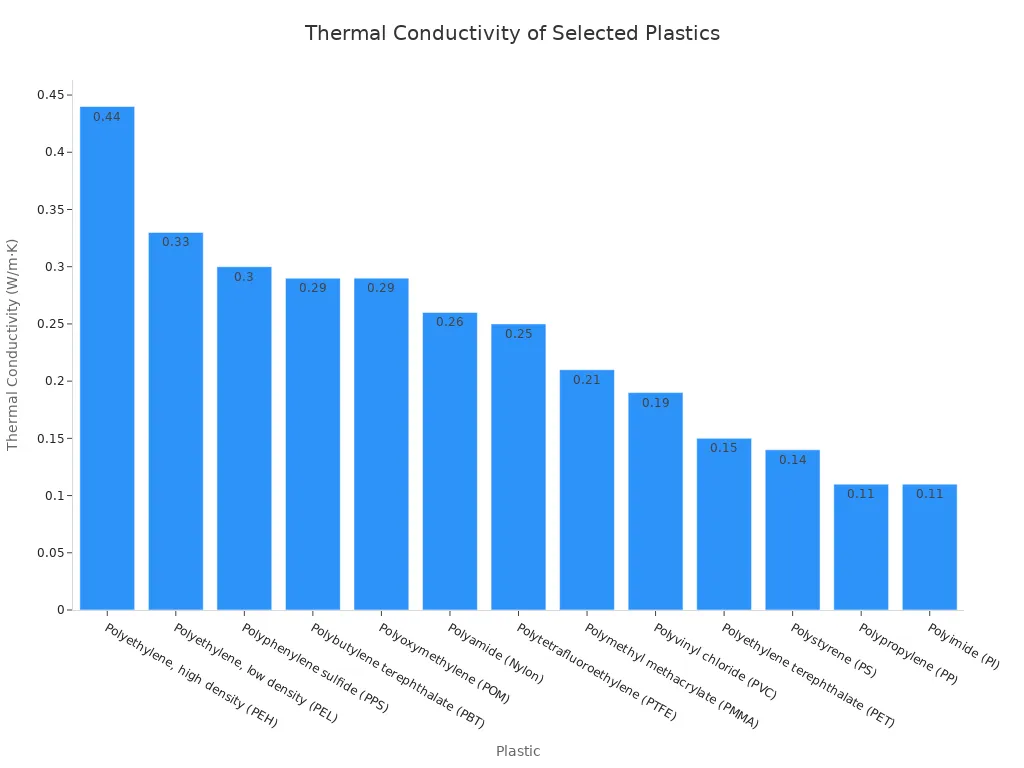
Plastic | Thermal Conductivity (W/m·K) |
|---|---|
Polycarbonate (PC) | 0.19–0.22 |
Polyamide (Nylon) | 0.26 |
Polybutylene terephthalate (PBT) | 0.29 |
Polyoxymethylene (POM) | 0.29 |
Polyphenylene sulfide (PPS) | 0.3 |
Polypropylene (PP) | 0.11 |
Filler choice makes a big difference. Graphene-based fillers reach 10³–10⁹ Ω/sq surface resistivity at only 0.3–2.0 wt% loading. This low load keeps the plastic easy to process. Superconductive carbon black needs 33–47 wt% to get below 10⁴ Ω/sq. That high load drops tensile strength from about 35 MPa to 20 MPa in polypropylene. Elongation drops from about 400% to 50%. Better blends with toughening additives and hybrid fillers keep tensile strength above 25 MPa and impact strength above 5 kJ/m².
Filler System | Loading Level | Surface Resistivity | Mechanical Performance |
|---|---|---|---|
Graphene-based | 0.3–2.0 wt% | 10³–10⁹ Ω/sq | Maintains processability |
Superconductive carbon black | 33–47 wt% | <10⁴ Ω/sq | Can weaken mechanical properties |
Carbon black in PP | 40 wt% | Conductive | Tensile strength drops to ~20 MPa |
Super Dragon's Polysesle Electronic and Electrical Materials line is a good example of a strong portfolio. This line meets strict electrical insulation and flame retardancy standards. When you choose a conductive plastics supplier, look for this kind of proven ability.
Inspect Batch Consistency and Certificates
Conductivity changes with filler dispersion. A supplier must prove batch-to-batch consistency. Ask about statistical process control methods. Good suppliers watch temperatures, pressures, and motor load on their extruders. They set control limits and check any value that goes beyond them. They also test dispersion quality with a microscope to spot agglomerates.
Category | Recommended Protocol |
|---|---|
SPC methods | Apply statistical process control to conductive masterbatch production |
Control chart parameters | Monitor temperatures, pressures, and motor load |
Lot testing – dispersion | Microscope exam to find agglomerates |
Lot testing – conductivity | Confirm loading exceeds percolation threshold |
Percolation threshold changes with additive type, particle shape, and dispersion quality. A supplier must confirm each batch goes above this threshold. They should also connect dispersion quality to better mechanical properties. Ask if they give a certificate of analysis for every batch. That document confirms the material meets your required resistivity and mechanical values. Without it, you cannot trace a field failure to a production lot.
Check Manufacturing, Supply Chain, and Cost
Passing material tests is not enough for production. The supplier's factory must meet conductivity specs when making large volumes. You must check their floor before you commit.
Confirm Scale-Up and Prototype Help
A good supplier knows molding. Conductive plastics shrink and flow differently than other plastics. They should offer gate design, DFM analysis, and mold-flow simulation. These tools protect conductivity during mold making.
Process control matters on the factory floor. Stable molding settings keep conductivity within limits. Ask for mold trial and production validation reports. Low defect rates show they can repeat it.
Real scale-up means flexible production. A strong supplier can do prototype runs, small batches, and large manufacturing. Mack Molding is a good example. Its dedicated teams connect prototypes to production. It also offers full-service assembly.
Grand View Research agrees. Suppliers gain preference with validated process windows, compatibility data, and process support. OEMs invest in approved supply chains and pilot lines. This shortens time to design wins. Pilot lines test real parts before mass production.
Material expertise in conductive shrinkage and flow
Gate design, DFM analysis, mold-flow simulation
Steady process control to meet conductivity limits
Mold trials, PPAP, production validation records
Engineering teams for testing and risk management
Flexible scheduling for any production volume
Compare Supply Chain Reliability and Total Cost
Dependable supply keeps your lines running. Ask about raw materials. Check backup suppliers and lead times. Think about location. A far supplier adds shipping risk. Lead times can stretch for weeks. A late shipment stops your assembly line.
Total cost is more than just the unit price. Add resin cost, reprocessing, scrap, logistics, tooling, and troubleshooting. A cheap compound often makes costly waste.
Large vehicle programs need thermal stability, long cycle life, and clear failure-mode data. These traits move materials from pilot projects to mass production. Without proof, the lowest quote becomes a costly gamble.
How to Choose a Conductive Plastics Supplier: Validate Before You Commit
You have made your list shorter. Now you must show each supplier can deliver. Validation keeps your project safe from pricey surprises. This step turns words into proof.
Request Samples, Trial Runs, and References
Start with a small test run. Use your real electronic device design. Mold a small batch of parts with the supplier's compound. Measure surface and volume resistivity on those parts. Check shielding effectiveness if your device needs EMI protection. Test mechanical properties after molding. Conductivity can change with flow patterns and gate locations. A lab sample may pass while a molded part fails. Run the pilot before you give full approval.
Ask for case studies in your field. Consumer electronics, medical devices, and automotive electronics each have their own needs. A supplier with medical device experience understands biocompatibility and sterilization. An automotive electronics supplier knows thermal cycling and vibration requirements. Request references you can call. Ask those references about batch consistency, delivery reliability, and technical support during production.
Score Suppliers and Formalize Quality Agreements
Build a decision matrix. Score each supplier on performance, quality, delivery, cost, and support. Weight each category based on your project priorities. A medical device may weight quality higher than cost. A consumer product may weight delivery speed and unit cost. The matrix gives you an objective comparison. It also documents your reasoning for audits and management review.
Document PPAP and quality expectations in a formal quality agreement. The PPAP package includes design documentation, engineering change notices, design FMEA, process flow diagrams, process FMEA, control plans, measurement system analysis studies, dimensional results, material and performance test records, initial process studies, qualified laboratory documentation, appearance approval reports, sample production parts, master samples, checking aids, customer-specific requirements, and the Part Submission Warrant.
Category | Documented Elements |
|---|---|
General PPAP elements | Design documentation; Engineering change documentation (ECN); Customer engineering approval; Design FMEA (DFMEA); Process flow diagram; Process FMEA (PFMEA); Control plan; Measurement System Analysis (MSA) studies; Dimensional results; Material/performance test records; Initial process studies; Qualified laboratory documentation; Appearance approval report; Sample production parts; Master sample; Checking aids; Customer-specific requirements; Part Submission Warrant (PSW) |
The quality agreement must also cover these elements:
Control Plan: Outlines quality checkpoints, checking procedures, frequencies, and corrective actions.
Measurement System Analysis Studies (MSA): Verifies that gauges and sensors are reliable and calibrated, often through Gage R&R studies.
Dimensional Results: Tabulates measurements from multiple samples to verify critical features meet specification and tolerance limits.
Records of Material and Performance Tests: Includes reports confirming chemical composition, strength, hardness, or electrical conductivity.
Initial Process Studies: Includes SPC analyses for critical processes to ensure they are free of major variations.
Qualified Laboratory Documentation: Includes certifications proving laboratory competence.
Appearance Approval Report: Documents customer sign-off after visual inspection.
Sample Production Parts: Parts provided before mass production to verify performance.
Master Sample: The final approved part signed by both parties, serving as the baseline standard.
Checking Aids: Custom fixtures, gauges, or templates with usage information and calibration records.
Customer-Specific Requirements: Additional test data, documentation formats, or quality checkpoints.
Part Submission Warrant (PSW): Certifies that the entire PPAP package is complete and consistent with customer requirements.
When you choose a conductive plastics supplier, treat this agreement as a binding commitment. It protects both sides. It also gives you a clear baseline for resolving disputes. A supplier who resists this documentation may not meet your quality needs. A supplier who welcomes it shows confidence in their process.
A good supplier proves material quality with batch certificates and test runs. They use statistical process control to stay consistent. They fix molding problems with strong technical support. They secure raw materials. Your line never stops. Price alone cannot deliver these protections.
Base supplier selection on records and facts. Score performance, quality, delivery, cost, and support in a weighted matrix. Start with your own application specs. Do every check before you sign an agreement. Ask for samples, run trials, check references, and put quality agreements in writing.
The right supplier becomes a long-term partner. They keep your product reliable and compliant through every production run. Choose carefully now. Build an edge that lasts.
FAQ
What should I check first when choosing a conductive plastics supplier?
Start with your own specification sheet. Confirm the supplier can meet your resistivity target. That means ESD dissipation or EMI shielding. Then ask for test reports for ASTM D257, ASTM D991, UL 94, and RoHS or REACH compliance. This paperwork filters suppliers out before you invest more time.
How do I know a supplier keeps batch consistency?
Ask how they use statistical process control. Good suppliers watch temperatures, pressures, and motor load on their extruders. They check dispersion quality under a microscope and confirm each batch passes the percolation threshold. Get a certificate of analysis for every lot. Without that paper, you cannot trace a field failure.
Is the lowest unit price a safe choice?
No. Costs hide in reprocessing, scrap, logistics, tooling, and troubleshooting when you buy a cheap compound. Add these to the resin price before you compare quotes. A supplier who secures raw materials and prevents line stoppages protects your production. Price alone cannot give you protection.
What documents should I request before signing an agreement?
Get a full PPAP package. It covers design FMEA, process flow diagrams, control plans, and measurement system analysis studies. It covers dimensional results, material test records, and Part Submission Warrant. Ask for a formal quality agreement covering control plans, corrective actions, and customer-specific requirements. These documents protect both sides.
How do I test a supplier before full approval?
Run a small pilot using your real device design. Mold a batch of parts with the supplier's compound. Measure surface and volume resistivity on those molded parts, not just lab samples. Check shielding effectiveness if your device needs EMI protection. Conductivity can change with flow patterns and gate locations.