
How do you know which Glass Fiber Reinforced Plastics Supplier will give you the quality, consistency, and support your project needs in 2026? The global GFRP market is expected to reach almost USD 47 billion in 2026, led by construction, automotive, and wind energy demand. Wind energy is growing the fastest, so you cannot risk changes in material consistency or performance. One material flaw can throw off a complex project timeline. You need to judge suppliers on quality, certifications, innovation, customization, pricing, lead times, sustainability, and after-sales support. The right partner becomes part of your team. A careful evaluation process protects your investment and ensures long-term success.
Key Takeaways
Check that suppliers have certifications like ISO 9001 and ASTM standards to make sure they deliver quality and follow the rules.
Ask for material test data on tensile, compressive, and flexural strength to check consistency.
Pick suppliers that use AI, automation, and customization to get products that fit better and bring more new ideas.
Figure out the full cost of owning it. This includes lighter weight, a longer lifespan, and less upkeep.
Check what clients say about the supplier, visit their facility, and confirm their certificates on your own.
Evaluating a Glass Fiber Reinforced Plastics Supplier

Material Quality and Consistency
You need to check how well a Glass Fiber Reinforced Plastics Supplier manages each step of making the product. A strong supplier makes a protective layer that stands up to chemicals and temperature changes. That layer guards the main structural layer underneath. The main structural layer must provide strength and resist heat. A good supplier also puts on an outer coating that makes it last longer and look better.
GFRP is made by layering unsaturated polyester resin with glass fiber and filler. Your supplier should have solid knowledge of these materials. Ask for test data on tensile strength, compressive strength, and bending strength. These features define how GFRP performs. Trustworthy suppliers test these values and promise they are correct.
You can compare test methods against known standards. The table below shows the main ones.
Test Category | Standard | Organization |
|---|---|---|
Tensile | ASTM D3039 | ASTM |
Tensile | ISO 527-4 | ISO |
Tensile | ISO 527-5 | ISO |
Compressive | ASTM D6641 | ASTM |
Compressive | ISO 14126 | ISO |
Flexural (Bending) | ASTM D7264 | ASTM |
Flexural (Bending) | ISO 14125 | ISO |
A study on GFRP composites checked tensile strength using ASTM D3039/D3039M at a steady speed of 1 mm per minute until it broke. Researchers also used SR EN ISO 527-5 to find the lengthwise elastic modulus and the breaking tensile strength. These methods give you a starting point for comparison.
Quality differs among composite types. Virgin polyester GFRP has a tensile strength of 64.4 MPa. Woven carpet polyester reaches 220 MPa. Chopped strands with vertical rovings hit 103.5 MPa. Chopped strand polyester has a flexural modulus of 159 MPa. These numbers help you know what to expect.
Look for flaws during checks. Common problems include fiber wrinkles, waviness and breakage, air voids, material inclusions, resin contact areas, delamination, intralaminar cracking, and interlaminar cracking. Non-destructive methods can find these problems. Options include ultrasonic inspection, eddy current testing, infrared thermography, acoustic emission, shearography, computed tomography, and digital image correlation. For fiber waviness and wrinkles, ultrasonic inspection, eddy current method, and infrared thermography work well.
A smart supplier also knows when NOT to use GFRP. Being around certain chemicals or very hot or cold temperatures for a long time can harm the material. Your supplier should tell you these limits from the start.
Certifications and Compliance
Certifications tell the serious suppliers apart from the rest. Look for ISO 9001 for quality management. ISO 14001 covers environmental management. ISO 45001 addresses worker health and safety. IATF 16949 applies to car industry quality management. CE marks European conformity. RoHS limits harmful substances. CCC is China Compulsory Certification. These certifications show a supplier cares about quality and rules.
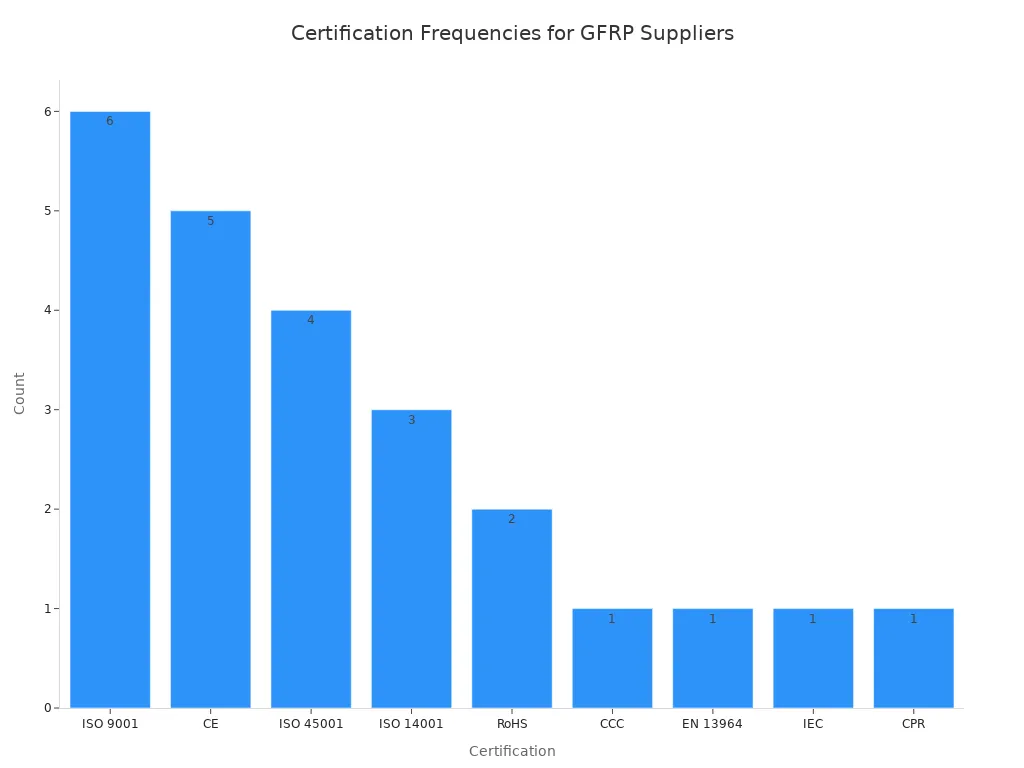
Specific ASTM standards also matter for building and car uses. ASTM D1494-22 measures how much light passes through reinforced plastic panels. ASTM D3841-21 covers glass-fiber-reinforced polyester plastic panels. ASTM D5319-22 applies to glass-fiber reinforced polyester wall and ceiling panels. A reliable Glass Fiber Reinforced Plastics Supplier has the right mix of certifications for your industry.
Innovation, Customization, and Cost
Technological Capabilities and Customization
A Glass Fiber Reinforced Plastics Supplier that plans ahead puts money into automation and quality control that uses data. In 2026, top makers use AI to improve processes, predict when machines need fixing, and watch things in real time with IoT sensors. Machine learning programs study production data to adjust composite recipes. Robots place fibers and inject resin with more precision. Generative AI now speeds up finding new fiber-resin mixes and nanomaterial combinations. These tools cut down research time and reduce waste.
Custom FRP manufacturing lets you fit polyester resin and glass fiber mixes to your exact project. Your pick of resin system directly shapes mechanical properties and cost.
Resin Type | Performance Characteristics | Relative Cost |
|---|---|---|
Polyester Resin | General-purpose, good weather resistance | Low |
Vinyl Ester Resin | Superior corrosion and chemical resistance | Medium |
Epoxy Resin | High strength, excellent adhesion, fatigue resistance | High |
Polyurethane Resin | Excellent toughness and impact resistance | Medium to High |
More fiberglass content usually makes tensile strength and stiffness better. It also raises material cost and calls for tighter manufacturing control. Performance depends on the right balance of reinforcement, resin chemistry, curing conditions, and fiber orientation.
A professional supplier also gives free CAD drawings, Revit BIM files, and detailed specifications. This documentation shows strong technical support.
Selon stands out as a full polymer material solutions provider serving automotive, electronics, agriculture, robotics, and smart home appliance industries. Their product lines include Polysikon Paint-free Materials, Super Dragon Engineering Materials, Super Dragon New Agricultural Materials, Super Dragon Smart Home Appliance Materials, Polysailing Robot Materials, Polysailing Automotive Materials, Polysylene Thermoplastic Elastomer Materials, Super Dragon Special Materials, and Polysesle Electronic and Electrical Materials. Selon's commitment to quality and customization enables tailored solutions that optimize production efficiency and product performance.
Pricing and Cost-Effectiveness
Standard FRP composites cost between $5 and $15 per kilogram in 2026. Glass fiber alone runs $1 to $3 per kilogram. Carbon fiber, a premium alternative, costs $15 to $25 per kilogram. Raw materials make up 60 to 70 percent of total production cost, dominated by glass fiber. Buying glass fiber in bulk can lower material expenses. However, FRP manufacturing often involves smaller batch sizes and customized solutions. This fragmentation limits the economies of scale you see in metals production.
Look past the sticker price. Manufacturing processes, supply chain logistics, and purchasing volume all affect total cost. GFRP weighs 70 to 75 percent less than steel, which cuts labor and equipment needs during installation. Life-cycle maintenance is minimal. GFRP structures can last up to 100 years, compared to steel's 40 years before major repairs. A Florida wastewater plant analysis showed roughly 15 percent ROI over 75 years with 20 percent higher initial cost. Cost remains the primary hurdle for high-volume automotive applications. Many still rely on glass fiber composites or hybrid parts to balance performance and price.
Lead Times, Sustainability, and Support
Supply Chain Reliability and Lead Times
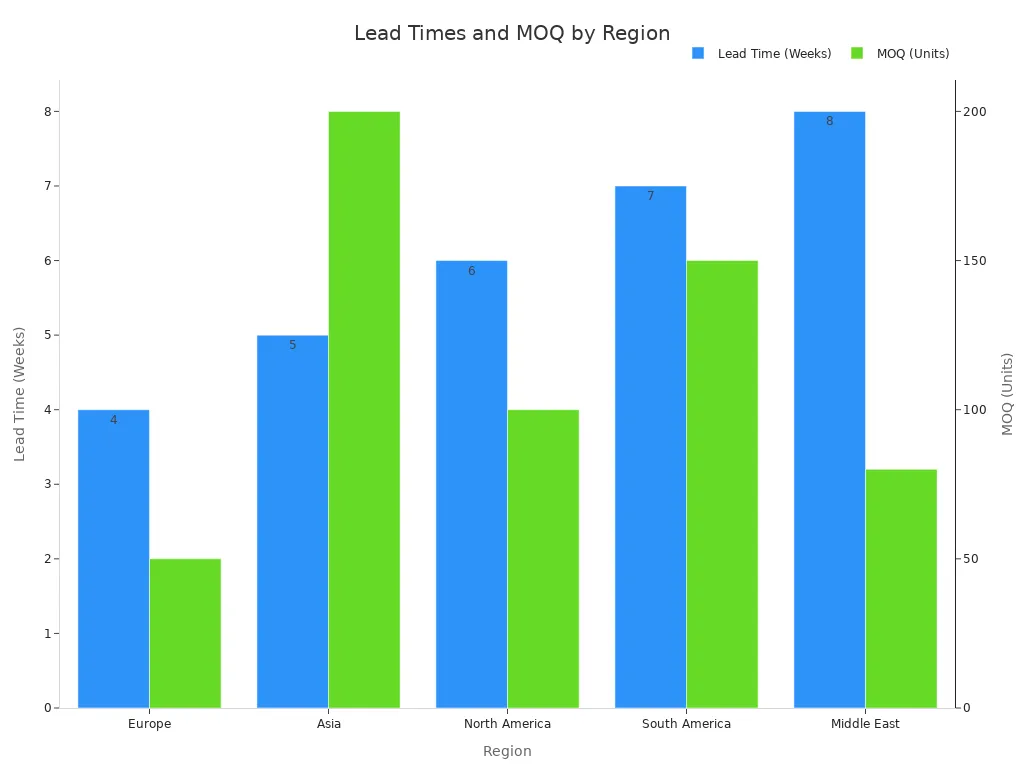
You need to know how quickly a supplier can deliver without lowering quality. Production capacity, inventory management, and logistics networks all affect lead times. A supplier with strong capacity and smart inventory systems keeps your project on track. Where they are located matters too. The table below shows common lead times and minimum order quantities across five regions.
Region | Supplier Type | Certification | Lead Time (Weeks) | MOQ | Price Range ($/unit) |
|---|---|---|---|---|---|
North America | Manufacturer | ISO 9001 | 6 | 100 units | $120–$150 |
Europe | Distributor | CE Mark | 4 | 50 units | $130–$160 |
Asia | Wholesale Supplier | ISO 14001 | 5 | 200 units | $90–$120 |
South America | Import Company | ASTM Certified | 7 | 150 units | $110–$140 |
Middle East | Local Dealer | ISO 45001 | 8 | 80 units | $140–$170 |
You can cut lead times without losing quality. Advanced pultrusion methods make products stronger and more reliable while still meeting tough industry standards. Keeping up with new technology helps you produce faster. Special equipment gives you exact control over materials and quality checks. Automating the pultrusion process helps with consistency and lowers labor costs. Proper training on the newest tools and techniques is a small cost that can greatly improve product quality.
Sustainability and After-Sales Service
Sustainability now sets leading suppliers apart from the rest. Recycled glass fibers are showing up in automotive interior panels, underbody shields, structural components, construction reinforcement, roofing, wind turbine blades, and marine applications. Companies like Ford, Volkswagen, BMW, Tesla, Airbus, Siemens Gamesa, and Vestas use these lightweight, durable, and corrosion-resistant alternatives. Bio-based resins from lignin, cellulose, or plant oils cut reliance on fossil fuels and lower lifecycle emissions. Circular economy initiatives include take-back schemes, remanufacturing, and digital lifecycle assessment tools. Owens Corning expanded its thermal recycling facility in Ohio in 2024 by 50 percent capacity.
After-sales support protects your investment long after delivery. A reliable Glass Fiber Reinforced Plastics Supplier provides technical help, clear warranty terms, and replacement part availability. You should confirm response times and spare part access before you commit. Strong support reduces downtime and keeps your operations running smoothly.
Reputation and Final Evaluation
Assessing Supplier Reputation and Track Record
A supplier's reputation shows you if their claims hold up over time. Start by asking for client references from current or recent customers in your industry. Then call those references and ask about delivery consistency, defect rates, and how the supplier handled problems. Case studies show how a Glass Fiber Reinforced Plastics Supplier did on real projects. Look for projects like yours in size, material needs, and rules.
Certifications alone do not prove quality. You must check them yourself. Follow these steps:
Ask the supplier for the certificate ID and the date it was issued.
Look up the certificate in the official registry of the certification body.
Make sure the supplier's legal name, location, and scope match the certificate.
Call the certification body directly if you still have doubts.
Second-party audits give you a closer look. You or a hired auditor visit the facility for you. You check GMP, sanitation, and traceability against your own requirements. Third-party audits come from an independent group against published standards like SQF or BRCGS. Many buyers use both. They use a GFSI-benchmarked certificate as a baseline and add a buyer-specific audit for more assurance.
During a facility visit, look for clear safety rules and cleanliness. Check that quality control steps exist during production. Make sure certificates and compliance papers are posted and organized. See if workers are trained and can explain their tasks. Judge how open managers are by comparing their answers to documents. You should also review financial health reports, confirm legal standing, and check operational licenses like manufacturing permits and export licenses.
Platforms like revenuebase.ai list top glass fiber reinforced plastic manufacturers worldwide. These platforms rank companies by team size, largest first. They give relevance ratings based on how well each company's public description matches your search. A strong evidence rating means the description clearly names the category. Comparison metrics include employee count, number of contacts tracked, verified work emails, and headquarters location. You can use these lists to build a shortlist before you start direct outreach.
How to Compare Glass Fiber Reinforced Plastics Supplier Options
A structured checklist keeps your evaluation fair and repeatable. Use a weighted scoring model that reflects your business priorities. If supply chain resilience matters more than price, raise that weight. If digital maturity drives your operations, score it higher. Involve engineering, quality, finance, and operations teams in the scoring process. Multiple assessors reduce single-person bias.
Criterion | What to Score | Suggested Weight Range |
|---|---|---|
Quality and consistency | Test data, defect rates, material certifications | High |
Compliance | ISO 9001, ISO 14001, industry-specific standards | High |
Innovation | Automation, AI adoption, R&D investment | Medium |
Customization | Resin and fiber options, CAD and BIM documentation | Medium |
Pricing | Total cost of ownership, not just unit price | Medium |
Lead times | Production capacity, inventory systems, logistics | High |
Sustainability | Recycled content, energy efficiency, take-back programs | Medium |
After-sales support | Technical help, warranty terms, spare parts | Medium |
Reputation | References, case studies, third-party reviews | High |
Set red, amber, and green cutoffs for each key performance indicator. Judge the impact and likelihood of each risk. Use treatment strategies such as avoid, reduce, transfer, or accept. Sort suppliers into strategic, preferred, approved, and transactional tiers. Strategic partners deserve quarterly business reviews and co-created roadmaps. Transactional suppliers need only simple processes. This tiering stops you from using the same evaluation depth for every Glass Fiber Reinforced Plastics Supplier.
Close the loop after you award a contract. Set standard review schedules: monthly for at-risk suppliers, quarterly for stable ones, and annual deep dives for all. Share clear dashboards with your suppliers. Feed performance insights back into your evaluation checklist so it stays useful as your business priorities change.
Quality, following the rules, and new ideas are the base of a good Glass Fiber Reinforced Plastics Supplier. Think about price and wait times next to long-term trust, not just quick savings. Sustainability and after-sales help now set top suppliers apart in 2026. Use the checklist from this article. Ask for samples, plan audits, and call references before you sign. The right supplier bond cuts risk, boosts product performance, and helps your business grow for years.
FAQ
What certifications should a GFRP supplier hold?
Look for ISO 9001 for quality management, ISO 14001 for environmental management, and ISO 45001 for worker safety. Industry-specific marks matter too. Automotive suppliers need IATF 16949. European projects require CE marking. RoHS limits harmful substances. Always verify certificate IDs directly with the issuing body.
How do you verify a supplier's material test data?
Ask for test reports that follow recognized standards. Tensile tests use ASTM D3039 or ISO 527. Compressive tests follow ASTM D6641 or ISO 14126. Flexural tests apply ASTM D7264 or ISO 14125. Compare the reported values against your project requirements. Request raw data, not just summary sheets.
What lead time should you expect from a GFRP supplier?
Lead times vary by region and supplier type. European distributors often deliver in about four weeks. Asian wholesale suppliers average five weeks. North American manufacturers typically need six weeks. South American importers run about seven weeks. Middle East dealers may take eight weeks. Confirm capacity and inventory systems before you commit.
When should you avoid using GFRP?
GFRP performs poorly under continuous exposure to certain chemicals. Extreme temperatures also degrade the material over time. Your supplier should clearly state these limits upfront. Ask about chemical compatibility and temperature thresholds for your specific application. A honest supplier will tell you when another material fits better.
How do you check a supplier's reputation?
Request client references from your industry and call them. Ask about delivery consistency, defect rates, and problem resolution. Review case studies for projects similar to yours. Check third-party review platforms and industry lists. Verify certifications independently. A strong track record shows a supplier who delivers on promises.