
Finding the right plastics manufacturer for EV components takes a clear plan. Electric vehicles need special plastics that handle heat, insulate electrical systems, cut weight, and last through years of tough conditions. The global EV plastics market shows this need. It hit USD 6.2 Billion in 2024 and will grow to USD 27.1 Billion by 2030, a 26.8% compound annual growth rate. This growth draws in both big chemical companies and specialized suppliers. The best partner depends on what a project really needs. To find a manufacturer well, buyers should follow five steps: define requirements, research options, evaluate capabilities, request quotes, and assess reliability before making a final decision.
Key Takeaways
Figure out what you need first. Make a list of material features, certifications, and your budget.
Look for manufacturers by using directories, trade shows, and referrals.
Look at their technical skills and quality control. Check for IATF 16949 and UL certifications.
Ask for price quotes and sample pieces. Compare how well they work, how long they last, and how they look.
Check how dependable they are. Look at their response times, lead times, and references before you choose.
How to Find a Manufacturer: Define Your Requirements
Material Properties for EV Components
EV plastics must handle high heat, UV light, chemical stability, and electrical insulation. Common uses include battery trays, module housings, breakers, switches, and trim fasteners. Each use needs specific performance features. For electrical safety in EV battery enclosures, buyers should check dielectric strength, resistivity, and tracking resistance.
Material Property | Required Value / Range | Notes |
|---|---|---|
Thermal conductivity (traditional plastics) | 0.2–0.5 W/mK | Naturally low; causes heat flow problems in high-current uses |
Thermal conductivity (engineered thermoplastic composition) | ≥ 1 W/mK | Made with 10–40 wt.% heat-conducting fillers |
Flame retardant content | 15–30 wt.% | Mixed with glass fibers (7.5–40 wt.%) for better flame resistance |
Flammability rating | UL 94 | Needed for junction box design |
Impact resistance | Dart impact at −35 °C | Needed for the thermoplastic composition |
Polysailing Automotive Materials offers custom polymer solutions for lighting, engine, interior, and exterior uses. These materials give off low odor, low emissions, and resist weather. Buyers can mention this brand when listing requirements for their own projects.
UL 94 V-0 is often asked for in flame-retardant plastics and composites. In this test, a material must stop burning within set limits. It also must not release flaming drips that set the cotton below it on fire. A UL 94 rating ties to the tested formulation and specimen thickness. Always ask for the test report or certification for a thickness equal to or below the production wall thickness.
Certifications, Volume, and Budget
Before contacting suppliers, buyers should list needed certifications. IATF 16949 is required for automotive-grade EV components. It covers BMS, battery electronics, motor controllers, inverters, ADAS, and telematics modules. UL compliance is required for EV components sent to the US and Canada. This is key for battery packs, BMS, power conversion units, and charging infrastructure. For EV connectors, flame retardancy is required. This means UL 94 V-0 or V-1 ratings, glow-wire rated per IEC 60695, and verified RTI and CTI.
Production volume and budget estimates help suppliers give accurate quotes. Buyers should figure out annual unit quantities, target piece prices, and tooling investment capacity. These numbers guide material selection and manufacturing method choices. A clear requirements list helps anyone who needs to find a manufacturer for EV plastic components.
Where to Find a Manufacturer: Research Options
Industry Directories and Trade Shows
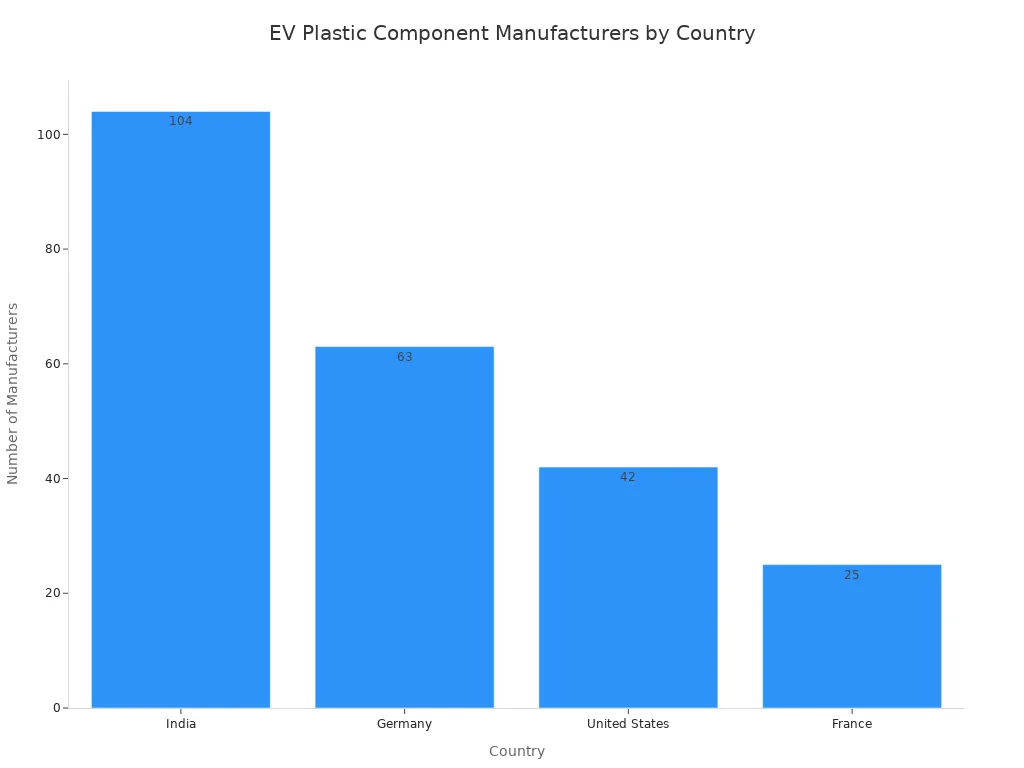
Industry directories help buyers quickly see who the suppliers are. Revenuebase.ai lists top EV plastic part makers by region. A September 2026 count shows 234 manufacturers around the world. India is first with 104 manufacturers, then Germany with 63, the United States with 42, and France with 25.
Country | Number of EV Plastic Component Manufacturers |
|---|---|
India | 104 |
Germany | 63 |
United States | 42 |
France | 25 |
RevenueBase SmartSearch uses plain-language company search to find manufacturers. Its data engine and AI look at a company's LinkedIn profile, self-supplied information, website, and other public data. Each company gets a rating of strong evidence, partial evidence, or indirect evidence. This method lets users describe a market in simple words and get matching companies with verified emails and direct dials.
RevenueBase's August 25, 2026 study looked at 4,198 description/company pairs across matching settings. It reports 86% of Exact matches rated good or better, and 77% for a 240-pair sample of one- or two-word categories.
A focused India search returns 141 company matches for EV plastic component manufacturers. These companies track 15,126 professional contacts, and 769 of them have verified work emails. Pune is the biggest hub for these manufacturers. Top cities by headquarters include Gurgaon (10), Pune (10), and Bangalore (8).
Trade shows let buyers meet suppliers in person. Companies like Hi-Rel Plastics & Molding in Riverside, CA, CEW Inc., and Piedmont Plastics help EV manufacturers with UL-certified, automotive-grade polymers. These events let buyers check samples and talk about technical needs directly.
Online Searches and Referrals
Online searches work well when buyers use exact terms. Queries like "EV battery tray plastic manufacturer" or "UL 94 V-0 automotive polymer supplier" bring back focused results. Buyers should check company websites for EV-specific case studies and certification documents.
Referrals from people in the industry often give the best leads. Colleagues who already source EV plastics can share what they know about lead times, quality, and communication. This feedback saves time and lowers risk.
Buyers can also compare big market players such as BASF, SABIC, LyondellBasell, and Evonik. These companies set high standards for material performance and documentation. Even when a buyer needs a smaller supplier, studying these leaders helps show what good looks like.
A structured approach helps anyone who needs to find a manufacturer for EV plastic components. RevenueBase offers a free account with 500 credits and no credit card required. Users can run the exact search for "electric vehicle plastic components manufacturers" filtered by country. They then work the top results, which include verified emails and direct dials. An upgrade unlocks all 4,507 verified decision-maker contacts tracked across the 234 companies worldwide.
Evaluate Manufacturer Capabilities
Technical Expertise and EV Experience
A good partner knows the special problems EVs bring. Battery packs need designs that use a lot of plastic. Fast-charging batteries need cooling solutions that are safe. Covestro gives examples of this kind of work. Buyers should check if a manufacturer can handle thermal management, sealing, and precision converting. Thermal management covers gap pads, phase change materials, and graphite parts that move heat inside cells, packs, and modules. Sealing and gasket work keeps water, dust, and air out of modules. It also holds dangerous materials in a crash and meets UL94 V-0 burn-test rules. Precision converting uses die cutting to make battery parts with exact shapes for heat shielding and electrical insulation.
Material partnerships matter too. A manufacturer with ties to leading material suppliers can pick the right polymer for thermal, insulation, and sealing needs. The table below shows common EV areas and the properties each one demands.
EV Component Area | Required Material Properties | Example Plastics / Expertise |
|---|---|---|
Battery enclosures / modules | Flame retardancy (UL 94 V-0), electrical insulation, dimensional stability up to ~125°C+, heat dissipation | Flame-rated polycarbonate, PC/ABS blends, glass-filled PBT |
Cooling system parts | Chemical resistance to cooling fluids, thermal stability, low friction, tight tolerances | Acetal (POM), glass-filled polypropylene |
Power electronics housings | Protection from heat and electrical faults, UL 94 V-0 rating | UL 94 V-0 thermoplastics |
High-voltage connectors | Tracking resistance, precision fit | Nylon 6/6, PBT |
Integrated assemblies | Molded cooling channels, EMI shielding, vent paths, sensor mounts in single parts | Injection-molded engineering-grade polymers |
Quality Control and Testing Standards
IATF 16949 certification is a basic requirement for automotive plastic makers, including EV suppliers. Certified suppliers use core quality tools such as Failure Mode and Effects Analysis (FMEA) and Statistical Process Control (SPC). These tools stop defects before they happen. They also cut field failures, ensure supply chain traceability, and hit target parts-per-million (PPM) quality levels. For critical components, a full Level 3 Production Part Approval Process (PPAP) is the normal expectation.
Buyers should review product validation testing. This confirms design suitability and covers leakage, proof-pressure, vibration, thermal cycling, and service-life tests. Routine production control keeps repeatability after design approval. It includes incoming material checks, critical dimension inspection, and batch traceability. Special Characteristics (SC) management requires tight SPC, mistake-proofing, and documented reactions for non-conformances. Suppliers must show process capability studies (Cpk, Ppk) on critical features. Anyone who wants to find a manufacturer should ask for these records before signing.
Request Quotes and Samples
The RFQ Process and Prototyping
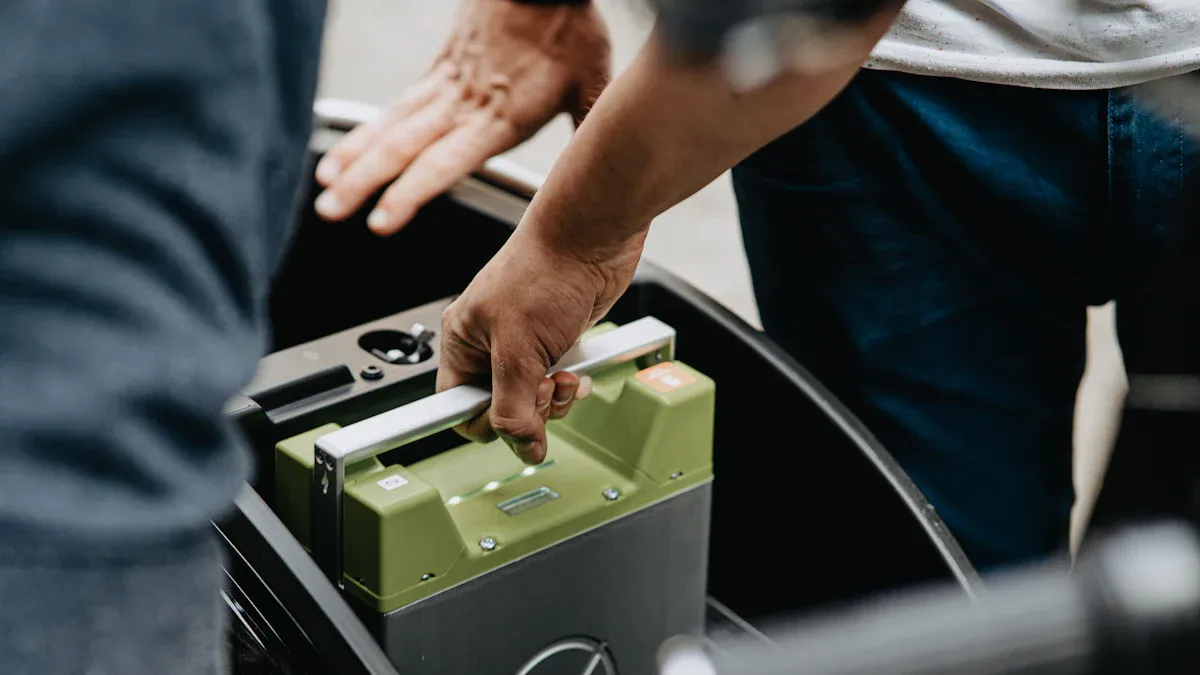
A clear request for quote (RFQ) starts with material specifications. Buyers should list the polymer type, filler content, flame-retardant rating, and color requirements. Volume matters too. Suppliers need annual unit quantities, expected order frequency, and target piece prices. Timelines should cover tooling lead time, first-article submission, and full production start. A complete RFQ helps any team that needs to find a manufacturer for EV plastic parts.
Prototyping comes next. Buyers should define the validation objective and quantitative acceptance criteria first. These criteria cover force, tolerance, temperature range, and wear cycles. The material behavior level should match modulus, shrinkage, and thermal expansion when validating structural or dimensional performance. Manufacturing method should align with purpose. 3D printing works for speed, CNC machining for tolerance, and soft tooling for molding behavior. Builders must control fabrication parameters and record process settings for repeatability. Structured tests then follow. These include load testing, environmental cycling, drop impact, and assembly verification with calibrated instruments. Teams document dimensions, deviations, failure modes, and environmental conditions against acceptance criteria. They iterate the design based on measured deviations and repeat validation until performance stabilizes within specification limits.
Polysailing's team responds within 24–48 hours as an example of prompt support. Fast replies keep prototype cycles short and reduce project delays.
Comparing Quotes and Sample Quality
Buyers should compare samples across three dimensions: performance, durability, and finish. The table below shows what to check.
Evaluation Dimension | Tests / Criteria | What to Compare Across Manufacturers |
|---|---|---|
Performance | Tensile strength, impact resistance, heat deflection; assembly and fit testing (snap-fits, press-fits); functional testing under real-world loads | Whether each manufacturer's material meets required strength, stiffness, and thermal thresholds for the intended application |
Durability | Durability testing simulating real-world use; environmental testing (heat, cold, moisture, UV); fatigue and wear assessment | Long-term performance consistency and resistance to environmental stress across suppliers |
Finish | Visual and tactile inspection for sink marks, warpage, flow lines, and flash; surface texture and appearance checks | Surface quality, cosmetic consistency, and defect rates between manufacturers |
Material properties guide the comparison. Mechanical strength requires similar tensile strength, modulus, and impact resistance to the intended production material. Thermal resistance depends on glass transition temperature, heat deflection temperature, and thermal expansion. Flexibility behavior needs matching elongation at break and elastic recovery for snap-fits, seals, and living hinges. Surface quality covers achievable roughness, texture replication, and coating compatibility.
Buyers should also test different plastic materials to determine which best suits the product's requirements. They evaluate strength, flexibility, and resistance to environmental factors. Functional performance under real-world conditions reveals issues that could compromise functionality. Manufacturability and cost reviews identify design elements that may pose challenges during mass production. This step streamlines workflow and reduces cost without compromising quality.
Assess Reliability and Make a Final Decision
Responsiveness, Lead Times, and References
How fast a manufacturer responds shows how they will treat a project after signing. Slow replies during the quoting stage often mean slow replies during production. Buyers should time how long a supplier takes to answer technical questions. They should also ask about standard lead times and compare them against project deadlines. Supplier tier affects these numbers directly.
Metric | Tier 1 | Tier 2 | Tier 3 |
|---|---|---|---|
Typical MOQ | 500–5,000 units/run | 100–1,000 units/run | 50–500 units/run |
Standard Lead Time | 12–20 weeks | 6–14 weeks | 4–10 weeks |
Certification Level | IATF 16949 mandatory | IATF 16949 common | ISO 9001 minimum |
Tooling Investment | $50K–$500K+ | $10K–$100K | $2K–$30K |
Customization Flexibility | Low (program-driven) | Moderate | High |
Typical Payment Terms | Net 60–90 | Net 30–60 | Net 30 / 50% deposit |
Tier 1 suppliers work directly with OEMs and manage complete system assemblies. They carry high MOQs and set lead times around automotive program launches. Tier 2 and Tier 3 suppliers are where most independent buyers operate. A buyer who goes to a Tier 1 supplier expecting Tier 3 flexibility will face structural incompatibility.
References matter as much as numbers. Buyers should contact past clients and ask about responsiveness, change control, and scalability. One EV OEM engineer noted that a partner's engineers helped tighten a machined cooling-plate design and iterate 3D-printed enclosure concepts early in development. That kind of support reduces delays and improves consistency.
"Quality certification in automotive manufacturing isn't a destination — it's a continuous operating requirement. IATF 16949 recertification audits occur every three years, with annual surveillance audits in between. Procurement teams that treat certification as a one-time checkbox are setting themselves up for supply chain failures." — Industry consensus among Tier 1 supplier quality directors, 2026
Contract Terms, Logistics, and Onboarding
Contract review should cover payment terms, tooling ownership, change-order procedures, and quality guarantees. Payment terms vary by tier, from Net 60–90 for Tier 1 to Net 30 or a 50% deposit for Tier 3. Buyers should confirm who owns the tooling and how the supplier handles design changes without disrupting quality.
Logistics planning covers shipping methods, packaging standards, and delivery schedules. Buyers should verify that the manufacturer can scale production from prototyping through bridge builds to high-volume launches. Onboarding should include a clear timeline for first-article submission, production part approval, and full production start. A smooth onboarding process sets the tone for the entire partnership.
Finding the right plastics partner for EV components follows five steps: define requirements, research options, evaluate capabilities, request quotes, and assess reliability. The best manufacturer balances technical expertise, quality, communication, and cost. Buyers should start with a clear requirements list and contact at least three potential suppliers. This approach helps anyone who needs to find a manufacturer with confidence. The EV plastics market will grow from USD 6.2 Billion in 2024 to USD 27.1 Billion by 2030. A long-term supplier partnership gives buyers stable quality, predictable lead times, and shared success in this expanding market.
FAQ
What certifications should an EV plastics manufacturer hold?
IATF 16949 is a must for automotive-grade EV parts. UL compliance is needed for parts sold in the US and Canada. For EV connectors, buyers need UL 94 V-0 or V-1 ratings and glow-wire ratings per IEC 60695. Suppliers must show process capability studies on critical features.
How long does a typical EV plastics manufacturing lead time run?
Lead times depend on the supplier tier. Tier 1 suppliers take 12–20 weeks. Tier 2 suppliers take 6–14 weeks. Tier 3 suppliers take 4–10 weeks. Buyers should compare these windows against project deadlines before they commit.
What material properties matter most for EV battery components?
Battery enclosures need flame retardancy, electrical insulation, and dimensional stability up to about 125°C. Cooling system parts need chemical resistance to cooling fluids and tight tolerances. High-voltage connectors need tracking resistance and a precise fit. Buyers should match properties to each use.
How quickly should a manufacturer respond to inquiries?
Fast replies keep prototype cycles short. Polysailing's team responds within 24–48 hours as an example of prompt support. Slow replies during quoting often mean slow replies during production. Buyers should time how long a supplier takes to answer technical questions.
Can buyers request prototypes before committing to full production?
Yes. Buyers should define validation goals and measurable acceptance criteria first. These criteria cover force, tolerance, temperature range, and wear cycles. Structured tests include load testing, environmental cycling, drop impact, and assembly checks. Teams repeat the design based on measured deviations until performance settles.