
In 2026, the right Modified Plastics Factory partner shows new materials, teamwork, and support from start to finish. Low price alone no longer means a supplier is reliable.
A factory with real R&D shortens your development time. It cuts trial-and-error costs and protects long-term supply stability.
You need a clear way to tell real technical partners from basic compounders. This post gives a five-step selection process. You will define needs, check options, test R&D depth, try samples, and set terms with quality checks. Each step builds on the last. Together they give you a repeatable way for smart sourcing choices.
Key Takeaways
Decide what materials you need and what kind of help you want before you begin your search.
Use directories, trade shows, and peer recommendations to build a strong shortlist of factories.
Check a factory's formula skills, testing lab, and quality certificates to see if they have real R&D depth.
Check samples using mechanical, thermal, and electrical tests before full production.
Talk openly about prices, who owns the tools, and set up regular checks to keep quality good over time.
Define Material and Support Needs
Specify Properties, Certifications, and Tolerances
You begin by turning your application into a material spec sheet. List the mechanical strength, thermal stability, chemical resistance, dielectric properties, flame retardancy, and weatherability your part needs. A modified PA grade with glass-fiber reinforcement works well for engine components and EV battery housings. A modified PBT grade gives dimensional stability and electrical insulation for connectors and sensors. Your spec sheet should match each property to the real load, temperature, or chemical exposure your part will face.
Material | Key Specifications | Typical Applications |
|---|---|---|
Modified PA | Glass-fiber reinforced; heat and chemical resistance | Engine components, EV battery housings |
Modified PVC | Cost-effective | Interior trims, wire harnessing |
Modified ABS | Balanced rigidity and surface finish | Instrument panels, radiator grilles |
Modified PBT | Dimensional stability; low moisture absorption | Connectors, sensors, LED housings |
Sustainability goals belong on the same sheet in 2026. Flag recycled content targets, VOC reduction, and recyclability. Super Dragon's Polysikon paint-free line eliminates traditional painting and cuts VOC emissions. Automotive buyers should note that EU end-of-life vehicle rules introduce phased recycled plastic targets. A grade like Borcycle GD3600SY carries 65.0% post-consumer recycled polymer content. Certification expectations vary by industry. Automotive, electronics, agriculture, and home appliance sectors each demand different proof of compliance. Name the standards your market requires without treating any single certificate as a universal guarantee.
Set Volume, Lead Time, and Budget Limits
Volume shapes every other decision. State your annual tonnage, your ramp-up curve, and your minimum order quantity tolerance. A factory that serves small pilot runs may struggle with high-volume contracts. A supplier built for mass production may not welcome low-volume specialty orders. Match your volume profile to the factory's real capacity before you shortlist anyone.
Lead time and budget work together. Give the factory your target delivery window and your cost ceiling. Ask how they handle raw material shortages or logistics disruptions. A realistic budget accounts for tooling, testing, and technical support, not just resin price. You protect your project when you set these limits early. The factory can then tell you honestly whether your timeline and budget fit their operation.
Research and Shortlist Modified Plastics Factories
Use Directories, Trade Shows, and Referrals
You need a place to start your search. Industry directories show you many suppliers at once. Thomasnet and RapidDirect list manufacturers by material type and region. You can filter by capability, location, and certification on these sites. In one afternoon, you can build a list of twenty or more candidates.
Trade associations add another layer. The Manufacturers Association for Plastics Processors (MAPP) holds training programs and networking events. Being a member shows a basic commitment to industry standards. You meet technical teams face to face at these gatherings. Talks at association events often show which factories put real money into R&D.
Trade shows put you in the same room as innovation leaders. The 2026 Injection Molding Innovation Summit happens on October 22, 2026, in Ohio. This event brings in suppliers who create new materials and processes. You can ask their engineers directly about formulation work. Ask what new products they launched in the past year. A supplier with nothing to show likely has no active development programs.
Referrals from peers matter just as much. Ask colleagues in automotive, electronics, or appliance manufacturing whom they trust. A recommendation from a buyer with similar material needs saves you weeks of screening. Use all three channels together to build the strongest shortlist.
Screen Modified Plastics Factories for 2026
A long list means nothing without sharp screening rules. You need a filter that tells true technical partners apart from basic compounders. Apply these checks to every candidate on your list:
R&D team expertise: Look for lab technicians and product developers who run polymer trials and turn market needs into real materials.
Innovation and patents: Pick companies that invest in new technology and hold patents.
Certifications and standards: Check that they meet TSCA, FDA, and RoHS requirements.
Customization capabilities: Choose factories that offer tailored materials, segmentation options, pricing analysis, and supply chain insights.
Reputation and references: Read client testimonials and success stories, then ask for direct references.
Site visits: Tour the facility to inspect equipment, R&D buildings, and overall commitment to growth.
During screening, ask each Modified Plastics Factory about its R&D experience and industry-specific projects. Ask for proof of certifications and examples of custom requests they handled. A factory with an in-house analytical lab, like the Plastics Analytical Laboratory (PAL) model, can run failure analysis and de-formulation work without hiring outside help. That skill shortens problem-solving cycles. Additive expertise matters too. A team that knows how to modify base resins with fillers, stabilizers, and flame retardants will meet your spec sheet faster. Collaborative new-product development sets a Modified Plastics Factory apart from a simple order-taker. The best candidates co-develop materials with you from the first trial batch.
Evaluate R&D and Technical Support
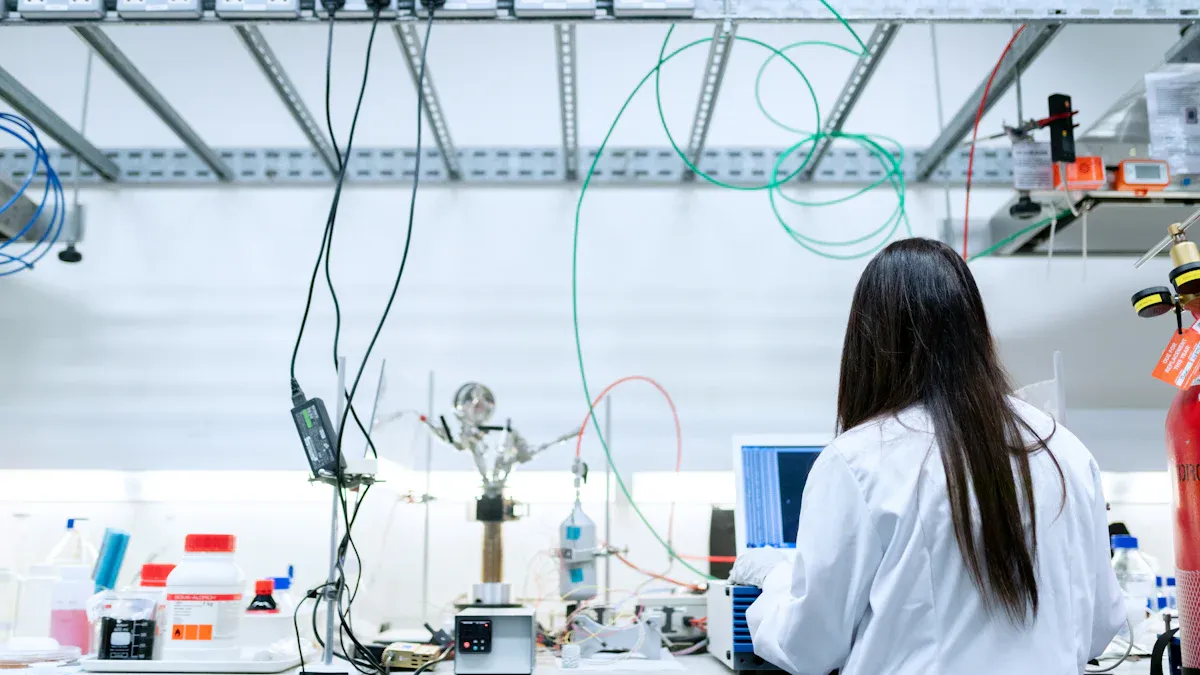
Checking a Modified Plastics Factory takes a careful look at its technical skills. Do not just read the sales brochure. Check how well it makes formulas, how good its testing lab is, and how strong its quality systems are.
Audit Formulation, Testing, and Mold Design
Start by checking how good the factory is at making formulas. The best ones work with many types of plastics, like engineering plastics, rubber-like plastics, special blends, and materials for electronics. Look at their past work for grades like yours. Ask if they have worked with materials like Super Dragon's Polysylene TPEs or Polysailing robot materials. That shows they can meet your needs.
Next, check how deep their testing goes. A real R&D lab runs specific tests on every new formula. Ask for data from these tests. Melt Flow Index (MFI) shows if the molecular weight is right. Izod and Charpy impact tests show if the material is tough. Heat Deflection Temperature (HDT) shows if it can handle high heat. Tensile testing checks overall strength. Moisture control is key, especially for Polyamide-based grades. The lab should also offer failure analysis and de-formulation. These skills let the factory copy a competitor's product or fix a problem fast. A factory with its own lab saves you from hiring expensive outside experts.
Mold design is also important. A good R&D partner gives you shrinkage data and mold flow simulations. They set up gate locations and cooling channels for your plastic grade. This stops warping and cuts cycle time before you make the mold. Ask for mold flow analysis data during your check. The R&D team should give advice for your specific use. They should explain how the material acts in a hot runner vs. a cold runner system. This support lowers your trial-and-error costs.
Check Quality Systems, Capacity, and Communication
Quality systems help make sure every batch is the same. Check for important certifications. The table below shows the key certifications for a Modified Plastics Factory that works in tough fields like electronics and cars.
Certification | Category | Purpose / Relevance |
|---|---|---|
IATF 16949 | Quality management | Controls every production step, emphasizes prevention and full traceability from raw plastic to final product |
ISO 9001 | Quality management | Establishes the core quality system, ensures each production run yields consistent results matching the same specs |
UL | Safety compliance | Covers flame resistance; materials pass burning tests, resist catching fire, and help final products pass safety checks |
RoHS | Environmental compliance | Limits restricted substances (lead, mercury ≤ 0.1% by weight; cadmium ≤ 0.01% by weight) in uniform materials including modified plastics |
Past certifications, check how much they can make and how they talk to you. A special technical support team makes help better. The right factory gives you one person for all technical questions. This person handles sales, marketing, and R&D for your account. That way, issues get fixed faster. It also sends routine requests straight to the lab. It saves you money because you do not need to hire your own plastic experts. A management team watches over everything. This team fixes problems before they hurt your schedule. Dashboards let you see your project status. These systems make the move from development to production smooth.
Picking a Modified Plastics Factory with these systems gives you long-term stability. You get a partner that can grow with your product plans.
Validate Samples and Performance
Run Mechanical, Thermal, and Electrical Tests
You must test every sample against your spec sheet before you start full production. Ask for tensile, impact, heat deflection, dielectric strength, and flame resistance data. Each test shows a different risk. Tensile and impact tests show if the material stays tough under load. Heat deflection testing shows how the plastic acts at high temperatures. The table below shows the standard methods and common test loads for HDT.
Standard Organization | Standard Designation | Equivalent Standard |
|---|---|---|
ASTM | ASTM D 648 | ISO 75 |
Common Test Loads for HDT | Typical Plastic Grades | |
--- | --- | |
0.46 MPa (67 psi) | Softer plastics (e.g., PE, LDPE) | |
1.8 MPa (264 psi) | Durable plastics (e.g., PEEK, PC) |
Dielectric strength matters for electrical parts. The test puts a flat sample plate under a slowly rising voltage between two electrodes. The voltage where the plastic loses its insulating properties is the breakdown voltage. Dielectric strength equals breakdown voltage divided by sample thickness. This analysis follows IEC 60243-1 or ASTM D149 standards.
Watch for common failure modes during validation. These include:
Material becomes brittle or cracks
Discoloration, streaking, or contamination
Unexpected softening, melting, or deformation
Supplier material does not match specifications
Aging, environmental exposure, or chemical attack
Not all beams fail by breaking. An alternate failure is defined by the resonance frequency dropping by 40% (the local stiffness cut in half).
Confirm Moldability and Pilot Production
Testing flat samples is not enough. You need trial runs to confirm the material flows and packs correctly in your actual mold. Ask for shrinkage data and mold flow simulations before cutting steel. Run a pilot production batch and check cycle times. Cycle time optimization allows identification of bottlenecks and adjustment of the time it takes for each unit to pass through the line, laying the groundwork for achieving the production goal.
Compare pilot results against your original spec sheet after each run. Write down every formulation adjustment the factory makes. If the supplier changes a stabilizer or filler, note the reason and the effect on measured properties. This record protects you during scale-up. A material that passes lab tests may still warp or short-shot in a multi-cavity tool. Pilot runs catch those problems early, when fixes cost less.
Negotiate Terms and Secure Quality
Clarify Pricing, MOQs, and Logistics
You need to know the full price before you sign anything. Ask the factory to list each cost separately: resin, additives, processing, and testing. One single price tag hides where your money actually goes. Ask for a price plan that shows lower costs as your order size grows. This helps you plan your budget over the life of your product.
Minimum order quantities keep the factory's production runs steady. Tell them your real yearly demand and your starting order size. A Modified Plastics Factory may drop or lower MOQs if you sign a long-term deal. Talk about who owns the tooling, and put it in writing. If you paid for the mold, you should own it. Make clear who stores it, who fixes it, and what happens if the partnership ends. For 2026 supply-chain strength, ask about backup sources for raw materials and extra shipping routes. A factory with backup plans keeps your line moving when problems hit.
Set Up Audits and Technical Reviews
Quality does not stay steady by itself. Plan regular audits at the factory. These audits check process controls, calibration records, and batch traceability. Batch traceability lets you track a finished part back to the raw resin lot. That matters when a part fails in the field. You can find the bad batch and protect the rest of your shipment.
Set up regular technical reviews with your factory's R&D team. Meet every three months to go over performance data and talk about material upgrades. Ongoing technical support should include material suggestions and guidance for your specific use. Your factory partner should know the demands of automotive, robotics, home appliance, agriculture, and electronics. Each industry has different tolerances, certifications, and failure risks. A factory that adjusts its support to your field solves problems faster. This partnership keeps quality steady as your volumes grow.
Use the five steps in this guide. First, write down what materials you need and what support you want. Next, look for factories using directories and trade shows. Then, check each factory's R&D team and testing lab. After that, test every sample with mechanical, thermal, and electrical tests. Last, talk about pricing, MOQs, and plan regular audits.
R&D and technical support show who is a real partner and who is just a seller. These things help solve problems faster and keep your supply steady as your products change.
Choose a factory that grows with your product plans. A partner with strong R&D can expand when your needs grow. Do not settle for a supplier that only fills today's order.
FAQ
What makes a real R&D partner in modified plastics?
A real partner shows skill in making formulas, runs its own testing lab, and builds materials with you. Look for in-house testing, knowledge of additives, and teamwork on new products. These things set technical leaders apart from basic compounders who just fill orders.
Which certifications should I ask for from a factory?
Your industry sets the rules. Automotive buyers need IATF 16949. Electronics work requires UL recognition and RoHS compliance. ISO 9001 helps keep output steady in all sectors. Name your market's standards early and check them during screening.
How do I check how deep a factory's testing goes?
Ask for mechanical, thermal, electrical, and failure analysis data. Ask about melt flow index, impact strength, heat deflection temperature, and dielectric strength results. A factory with de-formulation and new product development services solves problems faster and cuts your outside testing costs.
What should pilot production show before full-scale runs?
Pilot runs show real moldability. You get shrinkage data, cycle times, and flow behavior in your actual tool. Compare results against your spec sheet. Write down every formulation adjustment. This record protects you during scale-up and stops costly surprises.
How do I keep quality steady as volumes grow?
Schedule regular audits and batch traceability checks. Meet your factory's R&D team every three months. Ongoing technical support should cover material recommendations and guidance for your specific use. This rhythm catches drift early and keeps your supply reliable across automotive, robotics, appliance, agriculture, and electronics work.