
BASF, Covestro, Celanese, SABIC, DuPont, Solvay, Mitsubishi Engineering-Plastics, and Ensinger are among the engineering plastics manufacturers that make customized grades. Specialty compounders and fabricators such as Engineered Profiles, Port Plastics, Pexco, Petro Extrusion Technologies, Saint-Gobain, and TriStar Plastics add focused services. Customization covers reinforced, lubricated, flame-retardant, high-temperature, impact-modified, and color-matched formulations. Super Dragon Engineering Materials also supplies tailored reinforced, flame-retardant, and wear-resistant grades. Demand keeps rising across these segments.
Metric | Value |
|---|---|
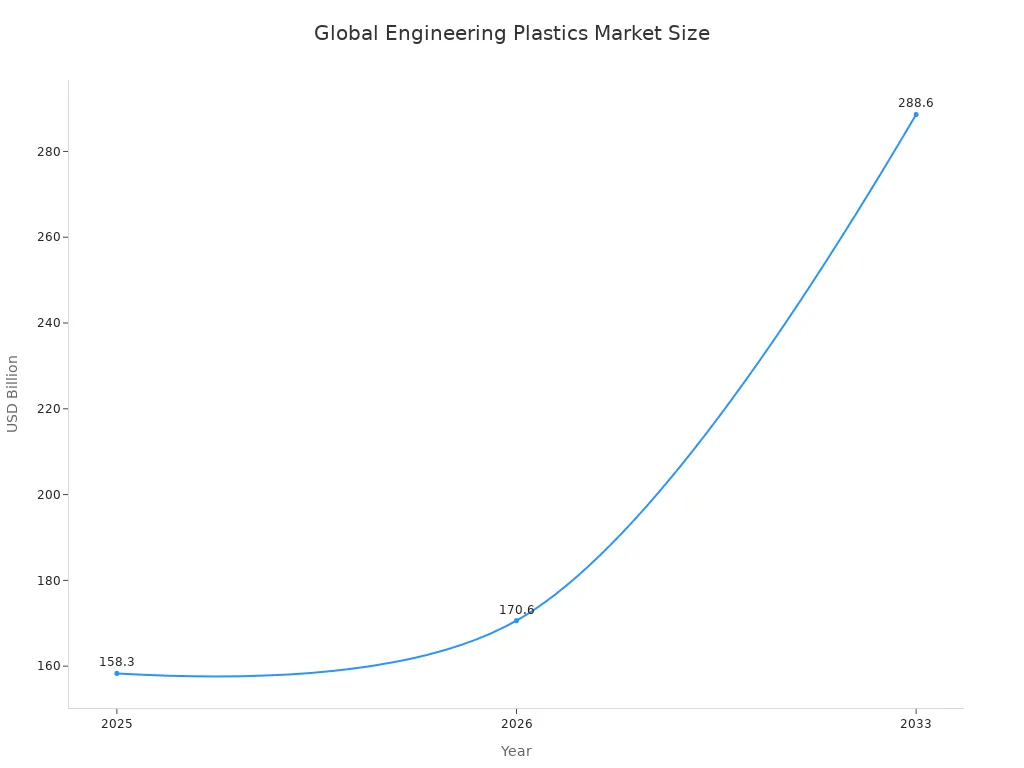
Market Size (2025) | USD 158.3 Billion |
Market Forecast (2033) | USD 288.6 Billion |
CAGR (2026–2033) | 7.8% |
Key Takeaways
Big resin makers like BASF and SABIC offer many products and strong technical help for large projects.
Specialty compounders focus on custom formulas and fast development batches for prototyping and mid-volume runs.
Fabricators turn raw materials into finished parts for small batches or parts with complex shapes.
Customization options include reinforcement, flame retardance, color matching, and impact modification to meet specific property needs.
Pick a supplier by listing the part's properties, checking compliance, and comparing cost and lead time with batch size.
Engineering Plastics Manufacturers and Their Capabilities

Global Resin Producers
Big resin makers bring worldwide supply, large research budgets, and application labs to custom compounding. BASF, Covestro, and SABIC each adjust mechanical, physical, chemical, and visual properties by compounding fibers, fillers, and pigments. They change flame resistance, water resistance, and recycled content without making OEMs switch their existing machines. Each company supports its product line with application labs, certification services, and local technical experts.
Capability | BASF | Covestro | SABIC |
|---|---|---|---|
Custom compounding (fibers, fillers, pigments) | Yes | Yes | Yes |
Property modification without machinery changes | Yes | Yes | Yes |
Industry-specific portfolios | Ultradur grades for food contact and drinking water | Medical-grade polycarbonate with sterilization paperwork | EV battery portfolio; medical-grade polycarbonate |
OEM collaboration | Yes | Yes | Yes |
BASF, based in Ludwigshafen, offers Ultramid, Ultradur, and Ultrason compounds for interior, exterior, structural, and under-the-hood parts. Covestro in Leverkusen focuses on polycarbonate and polyurethane systems for glazing, lighting, and battery enclosures. SABIC in Riyadh combines upstream integration with high-volume resin supply and global logistics. Celanese, DuPont, Solvay, Mitsubishi Engineering-Plastics, and Ensinger complete this tier with similar compounding and support depth.
Specialty Compounders and Fabricators
Specialty companies turn resins into finished shapes and add services that resin producers seldom offer. Port Plastics distributes and fabricates across 11 facilities nationwide. Its machining centers hold tolerances of ±0.001" from prototype quantities to production runs. The company stocks over 1,000 high-performance materials, including PEEK, PTFE, polycarbonate, and acrylic, in sheet, rod, and tube form. Value-added services such as cutting, routing, drilling, thermoforming, and welding shorten production time and lower costs.
Engineered Profiles handles custom profile extrusion. Pexco delivers high-performance plastic solutions, and Petro Extrusion Technologies works with polycarbonate, nylon, acrylic, and PVC. Saint-Gobain serves transportation, building, and industrial markets. TriStar Plastics specializes in self-lubricating bearing materials, and Cargill's Priplast polyol range supports PU modification. These engineering plastics manufacturers fill gaps that large resin houses leave open, especially in low-volume or highly shaped parts.
Super Dragon Engineering Materials sits within this landscape as a supplier of tailored reinforced, flame-retardant, and wear-resistant grades. The company pairs its formulations with R&D and material-selection support, which helps buyers move from specification to sample without losing consistency.
Customization Options and Development Process
Reinforcement, Flame Retardance, and High-Heat Grades
Glass-fiber and carbon-fiber reinforcement give engineering plastics their stiffness and strength. The fibers keep molecular chains from sliding when a load is applied for a long time. So a reinforced part holds its shape better than an unreinforced one. Long-fiber thermoplastics can handle nearly twice the stress of short-fiber compounds before they start to bend. The longer fiber network also spreads stress over a wider area, which improves fatigue life and resists cracks. Buyers gain four practical benefits:
High strength and stiffness with low weight
Resistance to weather and impact damage
Better moisture resistance than natural-fiber composites
Design freedom to add stiffness beyond the base resin
Flame-retardant grades serve safety-critical parts. Polyamide PA 2210 FR meets strict flammability, smoke, and toxicity standards for civil aerospace. It also qualifies for flying hardware at wall thicknesses down to 2 mm. Halogen-free systems such as FR30, FR40, and FR72 appear in Ultramid and Ultradur portfolios. They meet the EN 45545 railway standard across Hazard Levels HL1–HL3. Super engineering plastics, including PEEK, PPS, PTFE, PAI, and PI, carry UL94 V-0 ratings or higher. High-temperature grades keep these properties stable when parts run hot.
Color Matching, Impact Modification, and Workflow
Color matching follows a defined sequence. The compounder defines the color requirement, selects the polymer base and pigments, and prepares a trial formulation. Visual evaluation and spectrophotometer readings of ΔE and Lab* values guide step-by-step correction. Molding trials then confirm shade consistency across processing conditions. Impact modifiers soften brittleness in rigid grades, and they protect parts that face drops or sudden loads.
The spec-to-sample workflow moves through clear stages:
The customer submits specifications for engineering review.
The supplier selects the grade, form factor, and thickness.
Cutting, machining, and finishing shape the part.
Prototypes go to the customer for approval.
Production scales up with quality control.
Quality control covers material certifications, dimensional inspection, and standards such as ISO 9001, IATF 16949, and ASTM D638. This discipline keeps properties uniform from the first sample to the final shipment.
Matching Custom Solutions to Industrial Applications
Automotive and Electronics
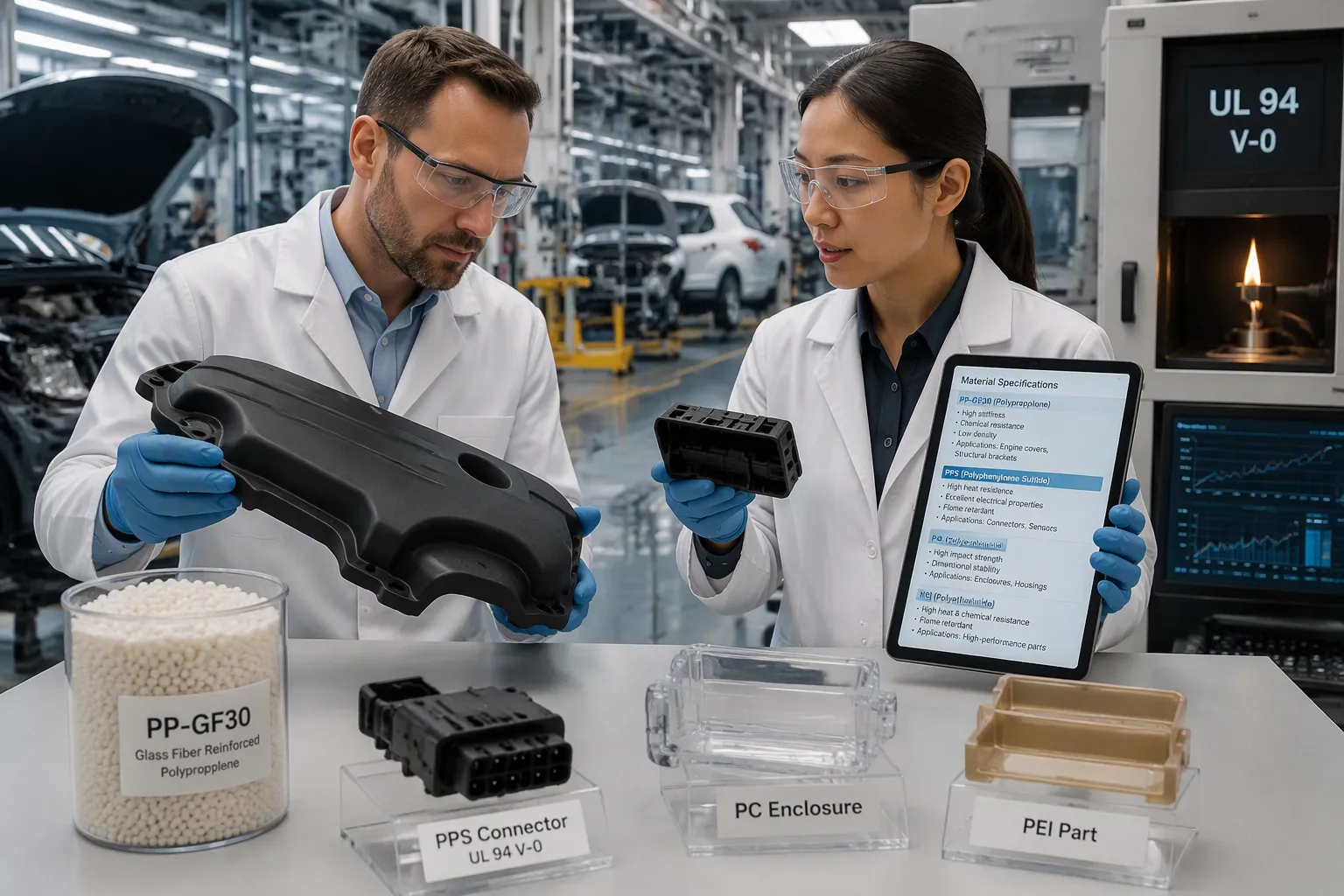
Car designers choose plastics that lower weight without losing strength. Polypropylene compounds are among the most common picks for under-hood parts and weight reduction. SABIC STAMAX and SABIC PP compounds balance high stiffness with impact resistance, even when hot. Long glass fiber-reinforced PP grades add strong dimensional stability and creep resistance, so structural engine-compartment parts keep their shape. Special grades with better hydrolysis resistance serve parts that touch coolants and other fluids. Modified PP with barium sulfate at 5–30 wt% and talc at 0.5–3 wt% raises heat resistance and surface hardness without costly elastomers. PP's low density improves fuel efficiency and cuts emissions, and its recyclability supports end-of-life sustainability. Under-hood plastics must also resist heat, chemicals, and vibration while still working in injection molding.
Electronics need flame-retardant grades that hold tight tolerances. The table below maps common material families to housing and connector duties.
Material | Strength for housings and connectors |
|---|---|
PPS | High-temperature electrical performance up to 220°C; excellent dimensional stability for tight tolerances |
PC | Impact resistance plus electrical insulation for enclosures and control panels |
PEI | Inherent flame retardancy and dimensional stability under sustained thermal load |
PA66 | Wide use in connector housings; flame-retardant grades available |
PBT | Electrical insulation and chemical resistance for connectors and relay housings |
LCP | Thin-wall flow and high-frequency performance for micro connectors |
FR PC/ABS | Non-halogenated UL 94 V-0 at thin gauges for server panels and rack components |
FR PPO/PPE | Lowest moisture absorption for busbar covers and terminal blocks |
One rule applies across the board: UL 94 classification belongs to the specific grade, color, and minimum thickness, not to the polymer name alone.
Medical and Industrial Machinery
Medical device housings rely on polycarbonate, ABS, and PC/ABS blends for injection molding. These resins offer low cost at volume, molding into custom shapes, and easy secondary machining. Silicone elastomer suits biocompatible keypads that make a smooth, cleanable surface near human skin. Buyers should confirm validation data for the intended sterilization method, such as autoclave at 134°C for 3 minutes, rather than assuming "steam-resistant" means "autoclavable." They should also ask for ISO 10993-5 cytotoxicity reports instead of accepting a "medical-grade" label. A documented PC/ABS blend with a UL 94 V-0 rating and ISO 10993-5 reports covers most non-implantable, non-sterile-field applications. Ingress protection follows the same logic: IP54 handles dust and splashes, while IP67 is needed only for routine submersion or high-pressure washdown.
Industrial machinery favors wear-resistant compounds for moving parts. Acetal (POM) shows a density of 1.41–1.42 g/cm³ against steel's 7.85, and its coefficient of friction of 0.1–0.3 beats steel's 0.5–0.8. It also runs quieter and resists corrosion. Nylon and acetal suit bearings, bushings, and gears; UHMW covers slide pads and wear strips with wear resistance roughly six times that of unfilled nylon. PEEK handles high-temperature and chemical-resistant niches up to 260°C, at 10–15 times the cost of acetal. Self-lubricating grades cut external lubricant needs, and field examples show the payoff: Nylatron NSM PA6 axle bearings last up to 20 times longer than alternatives, and Techtron HPV PPS conveyor bearings eliminate grease in steamy environments.
Comparing Engineering Plastics Manufacturers
Performance, Fit, and Compliance
Technical performance tells material families apart before it tells suppliers apart. Polyamide gives great wear resistance and mechanical strength for parts that rub a lot. Polycarbonate takes impact without cracking and holds up when temperatures swing. PEEK handles heavy loads, high heat, and harsh chemicals all at once. PPS gives thermal and chemical resistance under constant heat, and PET pairs stiffness with low moisture absorption. A supplier earns a spot on a shortlist when its lineup covers the property profile the part really needs.
Application fit and compliance then shrink the field. Medical work calls for ISO 13485 quality systems and FDA or USP Class VI paperwork. Electronics buyers look for UL 746A, UL 746B, UL 746C, and UL-94 data on the exact grade and color. Automotive programs expect IATF 16949. Exporters need CE, RoHS, and REACH coverage. Global resin producers hold broad certifications across many grades. Specialty compounders often go deeper on a small set of standards. Buyers should ask for certificates for the specific grade, not just the brand.
Cost, Lead Time, and Order Size
Order size shapes the comparison as much as price does. Specialty compounders and equipment suppliers run development batches of about 500–1,000 lb, while standard production runs sit near 20,000 lb. Regional custom compounders respond fast and flex on minimum order quantities, which suits mid-volume, fast-iteration work, though their material range stays narrower. Running below a compounder's economic batch size can trigger setup surcharges, and the size of that premium varies by supplier.
Global resin producers fit high-volume programs that need steady supply and deep technical backup. Specialty compounders fit prototyping and mid-volume runs that demand speed. Fabricators fit low-volume or highly shaped parts. Americhem, for example, advertises flexible manufacturing, short lead times, and low minimum order quantities across concept-to-scale-up work. These engineering plastics manufacturers each serve a different stage of the journey, so the right choice depends on batch size, timeline, and the certification list.
Customization is different for each kind of supplier. Global resin producers have many products and strong technical help. Specialty compounders focus on custom formulas and quick development batches. Fabricators turn stock materials into finished parts in small amounts. Each group covers a different stage of a project.
A simple plan helps you make the final choice. First, list the properties the part needs. Next, make sure it meets the rules for the target market. Then check references from similar programs. Last, compare cost and lead time with batch size. No single engineering plastics manufacturer leads in every category. The best fit depends on what the application needs.
FAQ
What does a custom engineering plastics grade include?
A custom grade changes the base resin by adding additives and fillers. Common changes include glass or carbon reinforcement, lubricants for moving parts, flame retardants, high-heat stabilizers, impact modifiers, and color matching. Suppliers adjust these elements to meet a set property profile, not a generic datasheet.
How does a buyer start a custom material project?
The buyer sends specifications for engineering review. The supplier then picks the grade, form factor, and thickness, shapes a prototype, and scales up production under quality control. Early steps matter most: a clear property profile and the target certification list save rework later.
Which industries use tailored compounds most?
Automotive and electronics lead demand. Cars need lightweight, heat-resistant parts; electronics need flame-retardant, dimensionally stable housings and connectors. Medical device housings and industrial machinery parts such as gears and bearings also rely on tailored grades. Each sector adds its own compliance requirements.
What should a buyer verify before ordering?
Buyers should confirm three things:
Certificates for the exact grade and color, not just the brand
Validation data for the intended sterilization or thermal process
References from similar programs
Cost and lead time come last, weighed against batch size.
Do small orders limit material choice?
Sometimes. Specialty compounders run development batches of about 500–1,000 lb, while standard production runs sit near 20,000 lb. Regional compounders are flexible on minimum order quantities, which suits mid-volume work. Global resin producers fit high-volume programs. Fabricators serve low-volume or highly shaped parts.