

You can find a polymer supplier with complete material analysis services in five steps:
Decide what kind of analysis you need.
Look for suppliers that have their own labs.
Check what tests they can do.
Compare your choices on performance, fit, compliance, and cost.
Confirm your pick with careful checks and trial orders.
Complete material analysis matters for three reasons. It lowers risk before you commit to a large order. It keeps each batch the same across production runs. It also helps with regulatory submissions by providing written test data.
Use these five steps as a framework you can repeat. Each one shortens your list and makes your evidence stronger.
Key Takeaways
Start by defining what you need to analyze. Make a list of the tests your polymer needs.
Pick suppliers that have their own labs. Look for accreditation and a wide range of tests.
Check the test reports and batch data. Stay away from suppliers who give unclear information or leave it out.
Compare suppliers by how well they perform, whether they follow the rules, and the total cost. Use a table with weights.
Check your choice carefully and place trial orders. Test samples from several runs.
Define Your Analysis Requirements
Key Tests to Require
Begin your supplier search with a clear list of tests. These common methods cover most polymer checking needs:
DSC (Differential Scanning Calorimetry) shows thermal changes, including melting point and glass transition temperature.
FT-IR (Fourier Transform Infrared Spectroscopy) identifies the polymer type by its chemical fingerprint.
SEM (Scanning Electron Microscopy) shows surface morphology and fracture behavior at high magnification.
XDF (X-ray Diffraction) reveals crystalline structure and phase composition.
Rheology measures melt flow behavior and processability.
Molecular weight and structure analysis shows chain length distribution and branching.
Resin identification confirms the base polymer grade.
Composition, additive, and filler analysis measures what else is in the material.
Each test answers a different question. Together, they build a full picture of the material you will receive.
Match Tests to Application Risk
Match how much you test to what is at stake in your application. A prototyping run may need only resin identification and a basic thermal scan. Mass production demands much more. Add batch-level DSC, rheology, and composition checks to catch drift before it reaches your line.
Recycled and bio-based polymers need extra attention. Their feedstock varies more than virgin resin. Require more tests for contaminant levels, additive content, and consistency across lots. Ask your supplier how they verify these materials lot by lot. A supplier with a complete lab can answer that question with data, not promises.
Identify Polymer Supplier Candidates
Where to Search
Start with directories that let you compare polymer testing providers side by side. Industry association listings and specialized lab directories often include filter tools for test type, location, and accreditation status. These platforms save time because you can screen many candidates before you make a single call.
Look beyond testing-only labs. Many polymer supplier candidates offer lifecycle testing that begins with raw material and resin verification and continues through finished-part validation. A supplier with this range can support you from incoming inspection to production release. Search industry trade show exhibitor lists and technical conference sponsor pages as well. These sources often surface suppliers with active lab programs.
First-Glance Screening Criteria
Check three things right away when a candidate shows up on your list. First, make sure the supplier has its own lab. A supplier with its own lab controls how fast it works and how good the data is. Second, check for accreditation or FDA registration. These credentials show the lab meets accepted quality standards for the tests it runs.
Third, look at how many tests the supplier offers. A polymer supplier with DSC, FT-IR, SEM, rheology, and composition analysis all in one place can handle most of your needs without sending samples elsewhere. A short test menu may still work for a single-purpose project. For full material analysis, though, a wide menu means fewer handoffs and delays. Notice which tests the supplier runs all the time versus once in a while. Regular testing shows real depth.
Evaluate Analysis Capabilities

Questions and Documentation
A Technical Data Sheet (TDS) is the first analysis document you get, and you should read it closely. TDS values usually come from lab tests under perfect conditions, so real-world results may differ. Environment, substrate conditions, and application technique can all change how the material performs. TDS documents often leave out long-term durability data beyond basic accelerated aging tests. They rarely compare the product directly to competitors or admit any trade-offs. They may not cover every application scenario, especially edge cases or unusual substrate combinations. In such cases, ask the supplier for more testing data or guidance for your specific use. That request also shows how well the supplier responds to analysis questions.
Use the TDS as a starting point for a deeper technical talk. Share it with the supplier and ask them to explain the numbers. A capable supplier will show how their material offers better value than one document alone can prove. Then check the TDS against a Certificate of Analysis (CoA). The CoA proves that a specific batch actually meets the specs stated on the TDS.
Ask for three more items: test reports, accreditation certificates, and batch data. Prefer recent independent lab reports from labs accredited to ISO/IEC 17025 or equivalent, referencing the exact product code or batch. Ask for a CoA per production batch with specific test methods, not generic "as per standard" language. A current GHS-compliant SDS and a full TDS are baseline documents. If a supplier cannot produce a TDS, that suggests a trading company without technical competence.
Weigh in-house labs against outsourced testing by fit. An in-house lab gives you speed, direct communication, and control over test scheduling. An accredited third-party lab gives you independent verification that carries weight in regulatory submissions. Many strong polymer suppliers use both: in-house screening for routine checks and named, accredited partners for formal reports. Neither model is inherently better; match the model to the evidence you need.
Red Flags to Watch
Watch for these warning signs during your evaluation:
Red Flag | Why It Signals a Reliability Problem |
|---|---|
Vague or missing TDS data | Suggests a trading company without technical competence |
No accreditation, or ISO 9001 scope covering a different facility | The certificate is not relevant to your product line |
Inconsistent batch-to-batch results | Points to poor process control |
Reluctance to share raw test reports | Suggests something is being hidden |
Weak tracking means slow root-cause analysis | |
Only discusses price and lead time | Signals a transactional mindset, not a partner |
Ask the average internal batch rejection rate. A rate above roughly 5% signals systemic quality problems. Ask how failed batches are handled. The answer reveals whether a genuine non-conformance process exists or the CoA is simply adjusted to pass. Confirm retention samples are kept per batch and accessible for dispute resolution. Confirm whether the supplier manufactures the product or sources it from others. A trading company presenting a manufacturer's CoA adds risk. Request samples from multiple production runs and compare them side by side.
Compare Polymer Suppliers
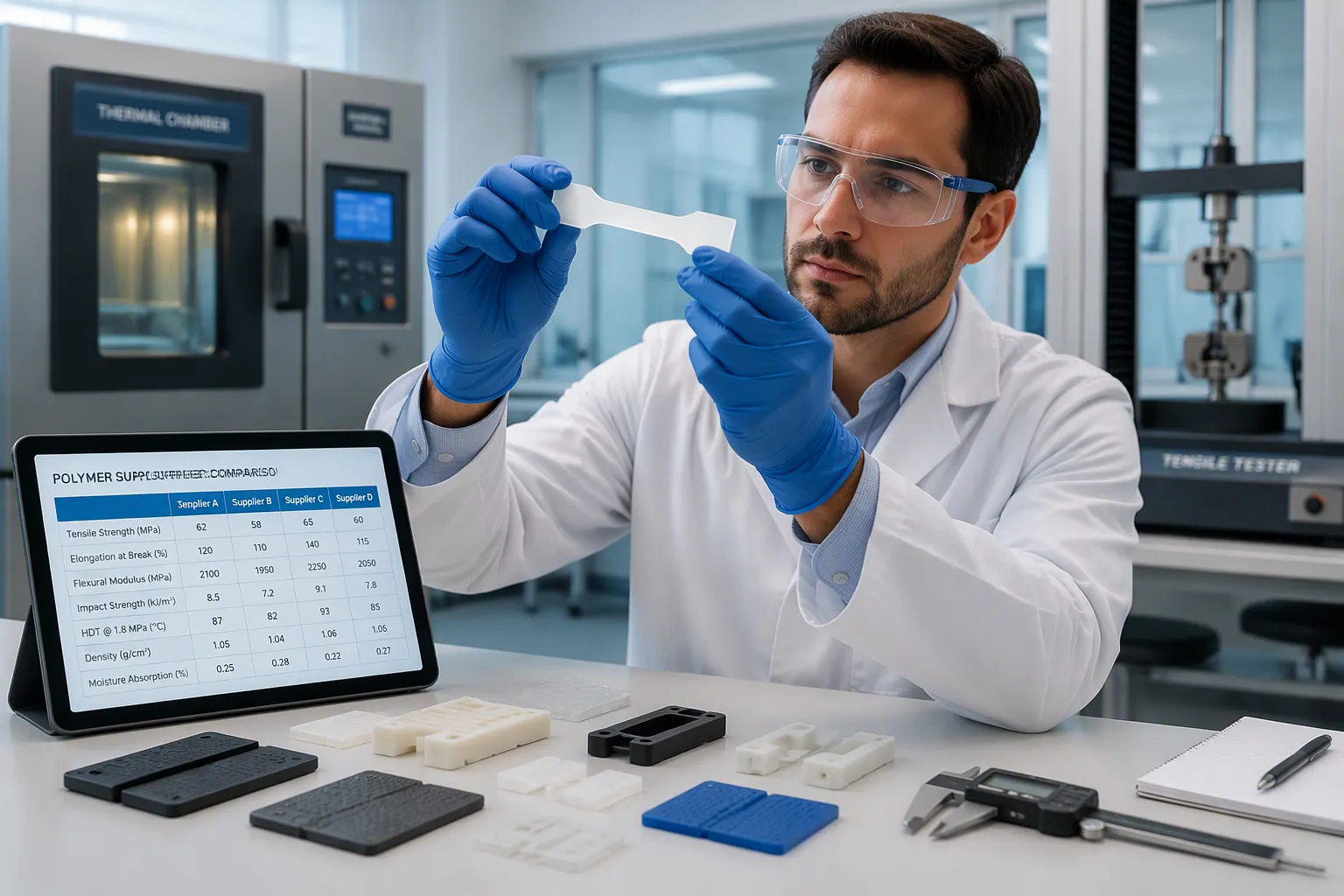
Technical Performance and Application Fit
Make a table that puts every candidate on your shortlist side by side. Give each one a score in five performance areas, then weight the scores to fit your application.
Dimension | What to Compare | Where It Matters Most |
|---|---|---|
Mechanical strength | Tensile strength, stiffness, impact resistance | Load-bearing parts and structural housings |
Thermal stability | Heat deflection temperature, melting behavior | Under-hood parts, electronics enclosures |
Chemical resistance | Resistance to oils, solvents, acids | Industrial machinery, fluid-handling components |
Flame retardancy | Rating achieved, additive loading required | Electronics, consumer goods with safety rules |
UV stability | Retention of properties after exposure | Outdoor and automotive exterior parts |
Your application decides the weighting. Load-bearing instruments need high tensile strength and stiffness, while flexible devices need elastomeric behavior. A part that touches tissue for a long time faces deeper biocompatibility testing under ISO 10993. The sterilization method also shapes the choice: PPSU withstands more than 1,000 steam autoclave cycles, while single-use instruments often use glass-reinforced PARA made for gamma radiation. Post-sterilization validation matters too, since some composites lose 17%–57% short-beam strength after 400 sterilization cycles.
Super Dragon Engineering Materials can serve as a reference point for application fit. The portfolio delivers mechanical strength, thermal stability, and chemical resistance, with formulations tailored for impact resistance, flame retardancy, or UV stability. Consistent batch-to-batch performance and compliance with international standards give you a stable baseline. The materials process easily by injection molding and extrusion, so design flexibility stays high from prototyping to mass production. Compare each candidate against this baseline. A supplier strong in flame retardancy fits electronics work best. A supplier with deep chemical resistance fits heavy industry. Match the option to the job.
Compliance and Total Cost
Regulatory compliance differs by sector, and each sector calls for different performance traits. General polymer production under cGMP guidelines demands purity, strength, and safety compliance through controlled processes. Food and beverage applications limit migration of harmful substances and require moisture barriers, tear resistance, temperature adaptability, sealability, and printability. Medical applications demand hygienic and mechanical properties, high barrier properties, puncture resistance, and clarity. Heavy industry demands chemical resistance, mechanical strength, durability, and operational safety. Check that your candidate holds the credentials your market requires, such as FDA compliance or ISO 13485 certification for medical market entry.
Then weigh compliance against total cost. Material price is only one line. Add testing service costs, retest fees for failed batches, and the engineering time spent chasing documentation. A cheaper resin that fails incoming inspection costs more than a priced-up grade with a complete CoA. Track melt flow behavior for recycled and composite polymers, since resin-to-reinforcement ratio, viscosity, and flow predict how a reformulated batch will perform. Confirm the supplier measures melt flow indexing to ASTM D1238 and ISO 1133-1, so numbers stay comparable across candidates. Additive manufacturing work should align with ASTM Committee F42 standards, which cover more than 70 methods for testing and qualification. A polymer supplier that documents every test against a named standard gives you numbers you can defend in a submission and compare across quotes.
Make a Final Decision
Due Diligence Checklist
Do three checks before you sign anything. First, confirm the lab accreditation directly with the issuing body. Make sure the certificate names the exact facility and covers the test methods you need. A certificate for a different site or a narrow scope tells you little about your product.
Second, compare the TDS against independent test data. Send a sample to an accredited third-party lab and compare the results with the supplier's published values. Small differences are normal. Large gaps, or missing data for a key property, deserve a direct question.
Third, review batch consistency records. Ask for CoAs from several production runs and compare the measured values side by side. Stable numbers across batches show real process control. Wide swings point to a problem you will inherit. Keep these records on file, because they support your own regulatory submissions later.
Trial Orders and Validation
A trial order is your last low-risk test before volume. Set it up to answer three questions: does the material meet your spec, does it match the supplier's claims, and does it repeat?
Start with sample testing on your own equipment. Run the resin through your actual molding or extrusion process and measure the parts. Then do a side-by-side analysis: test the trial material and your current material under identical conditions. Compare mechanical strength, thermal behavior, and flow. This step shows real application fit, not just lab fit.
Finish with reproducibility checks. Order samples from more than one production run and test them the same way. Consistent results across runs confirm the polymer supplier can hold a spec at scale. Write down every result and set clear acceptance criteria before the trial begins. Once the data passes, you can commit to volume with confidence.
You now have a path you can repeat: define what analysis you need, find suppliers with their own labs, check what tests they can do, compare them on performance, fit, compliance, and cost, then confirm your choice with careful checks and trial orders. Keep the analysis depth tied to your application and your market's compliance rules.
Use the comparison table and the due diligence checklist again on every future evaluation. They turn a choice based on feelings into a decision you can document.
Treat verified data as the base of a long-term partnership. A polymer supplier who shares batch records openly today will support your audits and product launches for years to come.
FAQ
How many tests do you need for a complete material analysis?
The number of tests depends on how risky your application is. A prototyping run may need only resin identification and a thermal scan. Mass production calls for batch-level DSC, rheology, and composition checks. Ask your supplier to explain why each test fits your spec, then add tests where a failure would cost you a lot.
Can a supplier's in-house lab replace third-party testing?
No single setup covers every need. An in-house lab gives you speed and direct communication for routine screening. An accredited third-party lab gives you independent reports that carry weight in regulatory submissions. Many strong suppliers use both, and you should confirm which lab makes the report you rely on.
How do you verify a lab accreditation claim?
Contact the issuing body directly and confirm the certificate names the exact facility and covers your test methods. A certificate for a different site or a narrow scope tells you little. Cross-check the TDS against an independent sample test before you commit to volume.
What should a trial order include before you commit to volume?
Set three goals: confirm the material meets your spec, confirm it matches the supplier's claims, and confirm it repeats. Run the resin on your own equipment, compare it side by side with your current material, and test samples from more than one production run.
Do recycled or bio-based polymers need extra analysis?
Yes. Their feedstock varies more than virgin resin, so require more tests for contaminant levels, additive content, and lot-to-lot consistency. Ask how the supplier verifies each lot. A supplier with a complete lab answers with data, not promises.