
Buyers looking for functional polymer materials for industrial uses can begin with a clear shortlist. Dow, BASF, Solvay, Arkema, Covestro, Evonik, Toray, Celanese, SABIC, 3M, DuPont, Heraeus, Idemitsu, Nippon Carbide Industries, Otsuka Chemical, and Specific Polymers all supply these materials on an industrial scale.
This guide uses four standards for every name on the list: technical performance, application fit, regulatory compliance, and cost. Each group of suppliers gets a short profile. A final section then explains how to choose among them.
Key Takeaways
Make a short list of suppliers based on what the material needs to do, such as packaging, electronics, or automotive parts.
Ask every supplier for a technical data sheet, a certificate of analysis, and a safety data sheet before design freeze.
Compare the total landed cost, including freight and secondary operations, not just the unit price.
Test samples under real process conditions to catch problems early and compare suppliers fairly.
Think about a custom formulation only when no catalog grade fits your needs. Just know that it will cost more and take longer to get.
Diversified Materials Majors
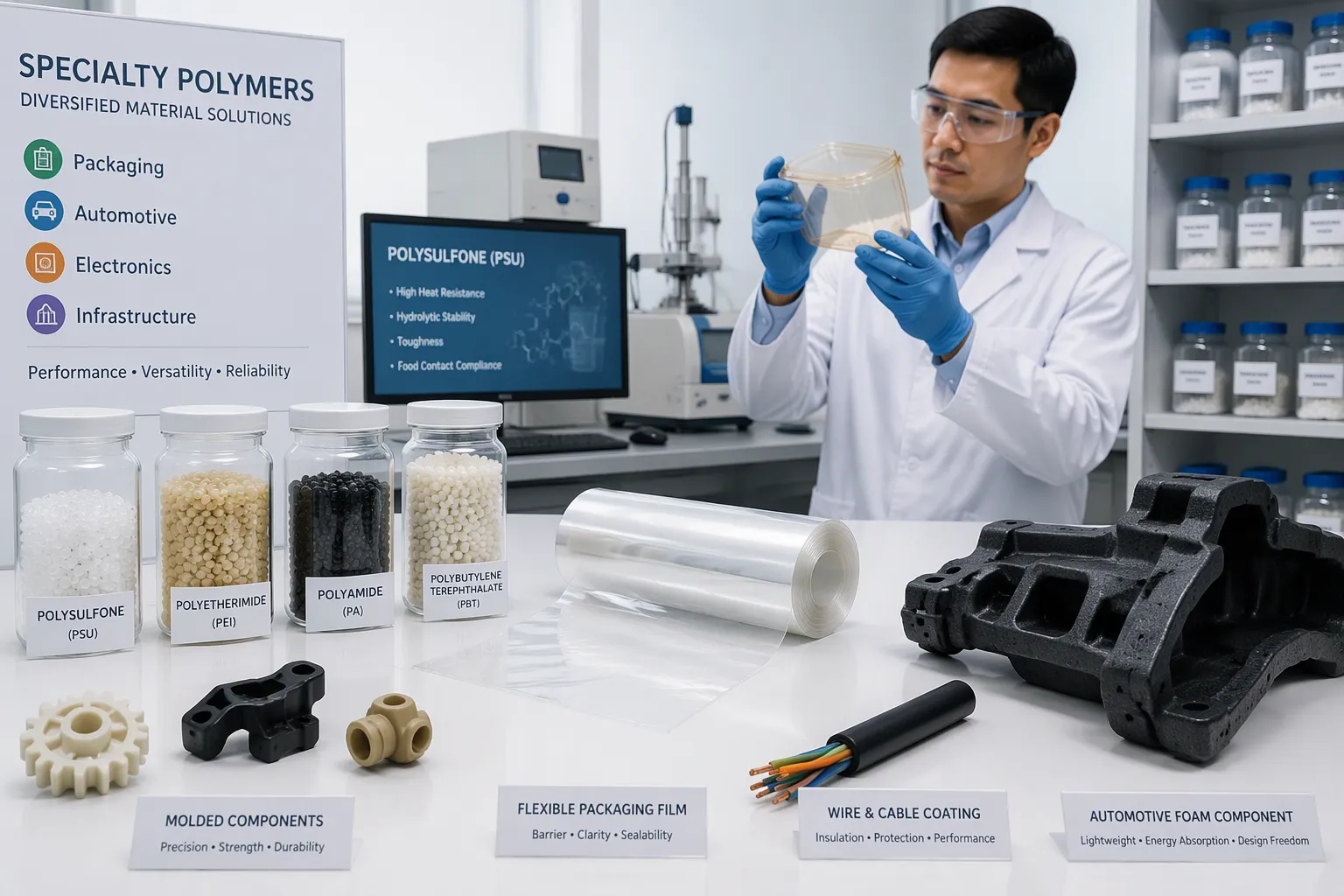
Big suppliers with many products serve lots of industries at the same time. Dow, BASF, Celanese, and SABIC each offer a huge range of grades and supply networks around the world. Their size helps them keep quality steady and give good prices on large orders. Each company also has its own strengths for particular uses.
Dow and BASF
Dow focuses its specialty polymer line on packaging, wire and cable, and infrastructure. The company's ELVAX™ EVA resins add flexibility, clarity, and stickiness to packaging films. SURLYN™ ionomers give toughness and impact resistance for delicate products. In wire and cable, AXELERON™ compounds deliver durability and electrical performance for telecom and power cables. SI-LINK™ compounds offer heat resistance and long-term stability in extreme conditions. For infrastructure, BYNEL™ adhesive resins help create strong bonds in multilayer construction materials. ELVALOY™ copolymers improve toughness and weather resistance in roofing membranes and asphalt. Dow's technical performance depends on this wide range of grades and steady output across regions. Application fit covers packaging, electrical systems, and construction. Regulatory paperwork covers global registrations, though how deep it goes varies by product line. Cost works best for buyers who order in volume, and lead times stay reliable through Dow's integrated supply chain.
BASF is a key market player with a portfolio that reaches packaging films, automotive parts, and electronics. The company's Ultrason® polysulfone grades serve food-contact parts without BPA or BPS, meeting EU Regulation 2024/3190. New Ultradur® PBT grades meet drinking water and food-contact rules. In automotive, Ultramid® Expand particle foam supports lightweight, crash-resistant components. Elastollan® TPU light guides serve interior and exterior lighting. Flame-retardant polyamide and PPA grades combine electrical insulation with heat resistance for high-voltage connectors and power electronics. BASF uses big research budgets and integrated supply chains to hold a strong market share across segments. The company's High Productivity Plus PA6 solutions allow shorter cycle times and lower energy use. Regulatory compliance is deep, with food-contact declarations and global registrations. Cost reflects volume pricing and regional manufacturing hubs that cut logistics expenses.
Celanese and SABIC
Celanese sells engineered polymers through well-known brand families. Celcon and Hostaform acetal thermoplastics have held long-standing positions in precision parts. Zytel polyamide serves automotive, industrial, and consumer applications. Crastin and Rynite polyester grades fit uses that need dimensional stability and electrical performance. Hytrel thermoplastic polyester elastomer supports flexible, durable parts. Santoprene thermoplastic vulcanizate serves automotive and industrial elastomer needs. Fortron polyphenylene sulfide handles high-temperature and chemically demanding environments. Vectra and Zenite liquid crystal polymers suit miniaturized electronic components. This breadth gives Celanese strong technical performance across diverse grades. Application fit covers electrical, automotive electronics, and industrial parts. The company's operating model emphasizes customer-embedded development, testing support, and consistent quality. Regulatory compliance includes flame resistance and environmental regulation conformity. Cost competes on delivered value for specific grades rather than broad branding.
SABIC pairs a wide polymer range with deep regulatory paperwork. The company publishes Safety Data Sheets, Regulatory Data Sheets, and Food Contact Declarations through its product portal. SABIC got compliance from the US Food and Drug Administration, the European Food Safety Authority, and the Japanese Ministry of Economy, Trade and Industry, among others. In 2022, the company assessed six polymers for environmental impact registration across regional agencies. It also characterized nine chemical substances to meet EU-REACH obligations. This depth of paperwork supports application fit in packaging, electronics, and automotive. Technical performance benefits from steady global production. Cost reflects volume pricing, and lead times stay predictable through regional supply hubs.
Specialty and Electronics-Focused Suppliers
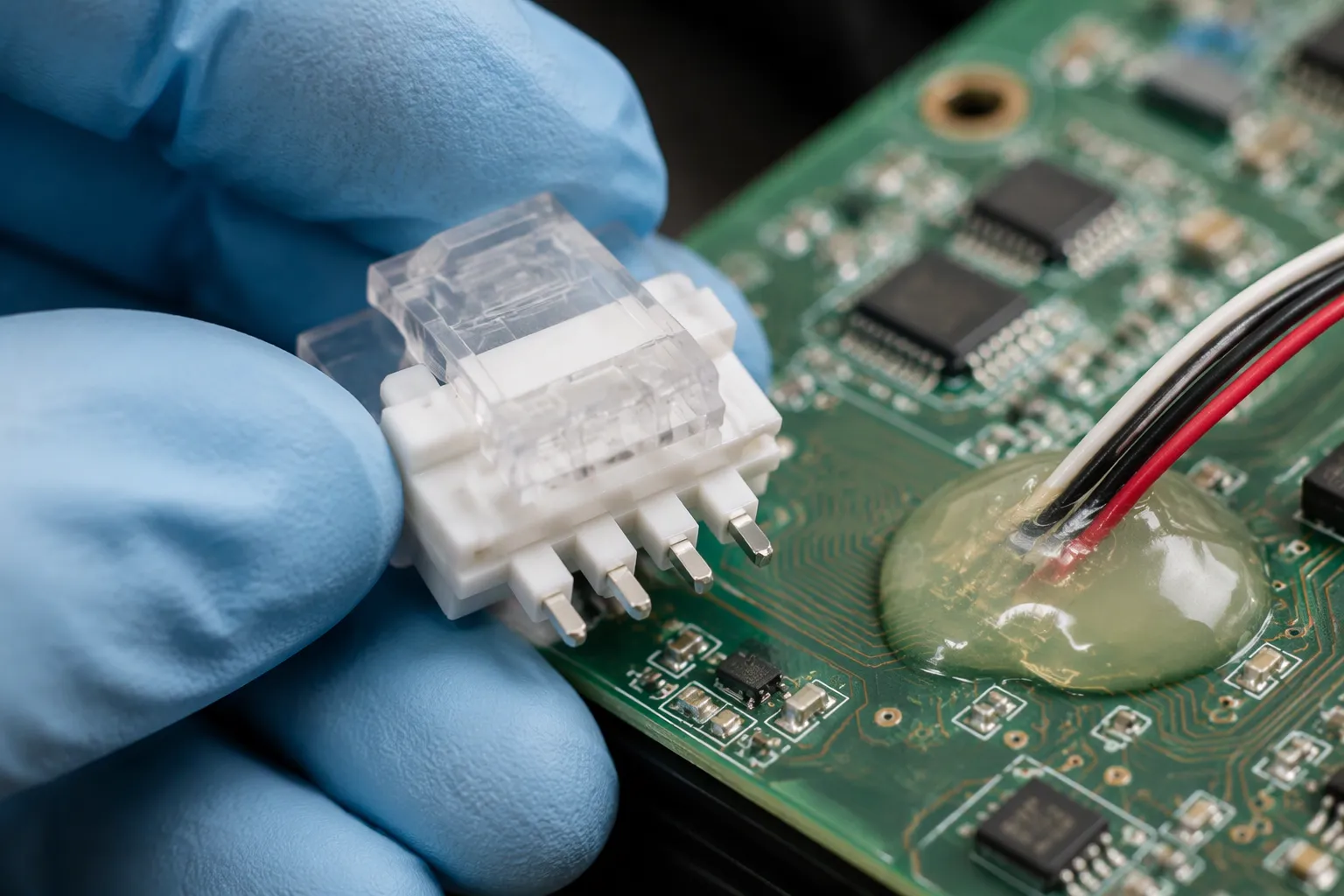
Specialty suppliers of Functional Polymer Materials focus on a few narrow material families. They give up breadth to gain depth in electronics, electrical insulation, and adhesives. Arkema, Solvay, Covestro, Evonik, Heraeus, Nippon Carbide Industries, Otsuka Chemical, and Specific Polymers each aim at these hard-to-serve niches.
Arkema and Solvay
Arkema runs its High Performance Polymers unit as a focused portfolio. The Kynar® fluoropolymer family gives extreme inertness in harsh environments, flame and smoke performance, electrochemical stability, and weather resistance. Kepstan® PEKK polymers serve high-temperature structural parts. Rilsan® PA11 resins and Rilsan® Clear transparent polyamides cover engineering and consumer uses. Pebax® thermoplastic elastomers combine polyamide and polyether blocks. They offer very low density, a wide shore hardness range, and efficient energy return across temperatures. Platamid® hot melt adhesives and Orgalloy® polyamide alloys complete the range. Technical performance rests on these specialized chemistries. Application fit leans toward electronics, electrical insulation, and adhesive bonding. Regulatory compliance covers global registrations for fluoropolymers and polyamides. Cost runs higher than commodity grades.
Solvay supplies high-performance polymers for electronics and harsh environments. Its sulfone and fluoropolymer lines support electrical components and semiconductor tooling. Technical performance emphasizes thermal stability and chemical resistance. Application fit covers connectors, insulation, and fluid handling. Regulatory documentation supports global electronics markets. Cost reflects premium positioning for critical parts.
Covestro and Evonik add polycarbonate, polyurethane, and specialty additive lines for electronics housings, potting, and insulation. Both offer strong technical support and global compliance paperwork.
Functional Polymer Materials for Electronics
Heraeus Epurio supplies Clevios® conductive polymers. Clevios® PEDOT/PSS leads the conductive chemistry field. It serves flexible displays, high-performance electrolytic capacitors, antistatic and shielding layers, and printed electronics. Heraeus also offers PriElex polymer thick film inks, including silver conductor inks AG-500A, AG-510, and AG-810, Ag/AgCl inks, carbon inks, dielectric inks, and conductive epoxies. These Functional Polymer Materials fit printed circuits and sensor assemblies.
Nippon Carbide Industries targets adhesives and electronic materials. Its functional polymers serve adhesives from automobiles to televisions and smartphones. Adhesives for polarizing plates support LCD panels in televisions, smartphones, tablets, and PCs. Melamine resin Nikalet ECR works as a semiconductor mold cleaning material.
Segment | Material | Application |
|---|---|---|
Functional Polymers | Adhesives and coating raw materials | Autos, TVs, smartphones, paper, textiles |
Functional Polymers | Polarizing plate adhesives | LCD panels |
Electronic Materials | Melamine resin Nikalet ECR | Semiconductor mold cleaning |
Otsuka Chemical builds TERPLUS polymers with its proprietary TERP method, a controlled radical polymerization. The process yields uniform molecular weights and controlled structures such as block polymers. The D Series pigment dispersants serve color filters and inkjet inks. The N Series adhesives serve optical films, electronic materials, and hot melt bonding.
Series | Type | Applications |
|---|---|---|
TERPLUS D | Pigment dispersants | Color filters, inkjet inks, paints |
TERPLUS N | Adhesives | Optical films, electronic materials, hot melts |
Specific Polymers offers a custom specialty polymer range for research and production. Buyers gain tailored structures and small-batch flexibility.
Regulatory compliance matters most in this cluster. UL 746 provides a framework for assessing polymeric materials in electrical products. UL 746E covers laminates and printed wiring board materials. UL 746F applies to flexible dielectric films. RoHS and REACH restrict hazardous substances. UL 746R helps manufacturers evaluate restricted substances. Buyers should confirm these documents before design freeze. Cost varies widely, and custom grades carry higher prices and longer lead times.
High-Performance and Application-Specific Players
Toray and Idemitsu
Toray builds a high-performance polymer range around TORAYCON™ PBT resin. This polybutylene terephthalate gives great electrical properties and chemical resistance in many grades and colors. Toray reports a melting point of 224°C and continuous use from 120°C to 140°C. The resin soaks up very little water, so molded parts keep their exact shape. It also hardens fast, which shortens molding cycles and improves how parts look. These traits make TORAYCON™ a strong fit for electronic and electrical components and automotive parts. The 5008 series meets T4 (150°C) or higher of the USCAR standard, and grade 1251G-30 HL passes laser light for galvano-scanning laser welding. Toray supports automotive ECU cases, junction boxes, and battery gaskets with low-warpage and flexible grades. Regulatory compliance covers flammability and glow wire performance, and PFAS-free grades are possible. Cost reflects engineering-grade pricing, and lead times depend on grade and region.
Idemitsu positions its Functional Polymer Materials for automobiles and next-generation applications. The portfolio reaches paint-free surfaces, engineering materials, agricultural materials, smart home appliance materials, robotics materials, automotive materials, thermoplastic elastomers, and electronic and electrical materials. Technical performance stresses durability and surface quality. Application fit spans mobility, appliances, and agriculture. Compliance paperwork supports global automotive and electronics markets. Cost varies by formulation, and custom grades take longer to deliver.
3M and DuPont
3M uses its adhesives and film know-how for Functional Polymer Materials that bond, insulate, and protect. Technical performance rests on steady adhesive chemistry. Application fit covers electronics, automotive, and appliance assembly. Regulatory paperwork supports global markets. Cost works best for buyers who need ready-made solutions rather than custom synthesis.
DuPont offers engineering polymers and thermoplastic elastomers for tough end uses. Its portfolio serves automotive, electronics, and industrial parts. Technical performance stresses toughness and heat resistance. Application fit covers connectors, seals, and structural components. Compliance paperwork is deep across regions. Cost reflects premium engineering grades.
Custom formulation and co-development add value here. Development partnerships, such as the Fraunhofer IFAM-style model, let buyers tune a polymer to a specific functional requirement before scale-up.
Comparing Functional Polymer Materials Suppliers
Matching Performance and Application Fit
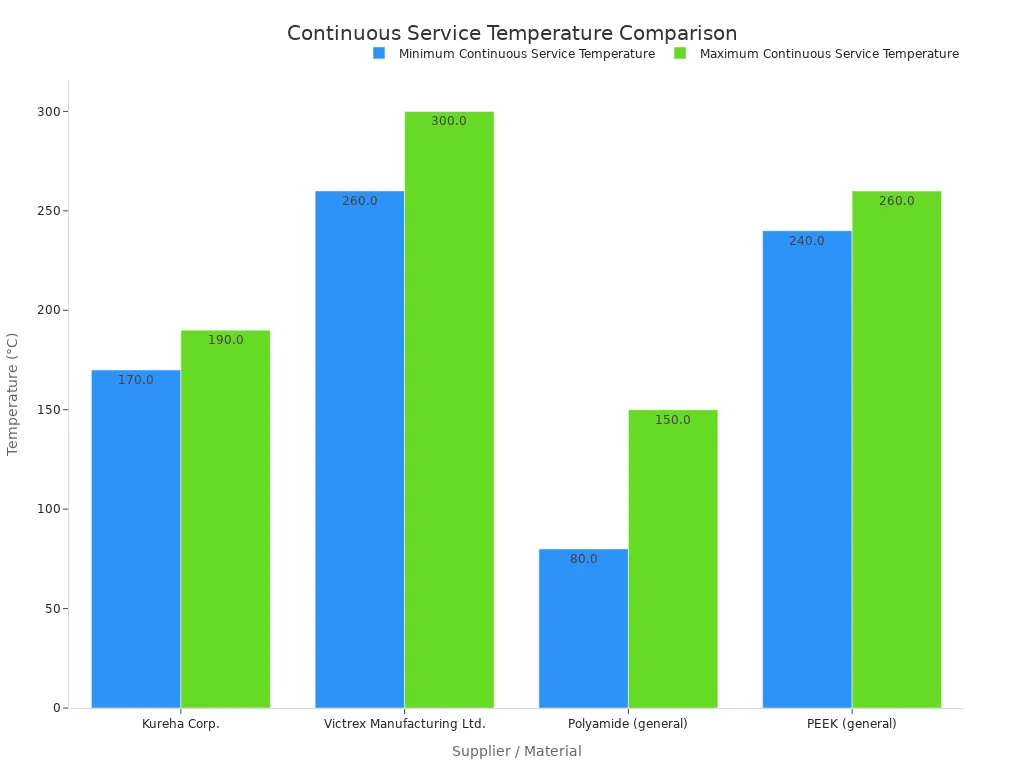
Technical performance helps you narrow the list fast. General polyamide grades work from 80°C to 150°C, while PEEK grades hold 240–260°C in air, according to PatSnap. The chart below, from PatSnap, compares continuous service temperatures across supplier families.
Application fit narrows the field even more. Kuraray reports that about a third of the roughly 30,000 parts in a car are plastic, and four polymers cover over 70 percent of automotive plastics. Dow and BASF work well for packaging and infrastructure. Arkema, Heraeus, and Nippon Carbide Industries fit electronics and adhesives. Toray and Idemitsu serve automotive and appliance parts. Buyers should write pass/fail rules before sampling and test under real process conditions, as Acta Biotechnology advises.
Weighing Compliance and Cost
Regulatory paperwork depends on the target industry. Peflon lists REACH and SVHC declarations, RoHS 3, FDA 21 CFR 177.1550 for food contact, UL94 flame ratings, and IATF 16949 for automotive programs as common requirements. Medical buyers also need USP Class VI reports. Ask every candidate for a current TDS, a recent-batch COA, and an SDS.
Cost follows material tier. Commodity resins sit at the low end, and engineering grades such as PEEK cost much more, per Exintell Machinery. Tooling costs spread across order volume, so the effective piece price drops as run length grows. Model total landed cost with freight and secondary operations, not just the ex-works unit price. A short decision path works well: match the functional requirement to supplier specialty, confirm regulatory documentation for the target industry, then compare landed cost and lead time. These steps let buyers compare Functional Polymer Materials on equal terms, and the same discipline keeps Functional Polymer Materials sourcing predictable across regions.
The shortlisted companies are different in clear ways. Big suppliers like Dow and BASF offer many grades and lower prices for large orders. Specialty suppliers like Arkema and Heraeus focus more on electronics and adhesives. High-performance players like Toray and Idemitsu aim their products at automotive and appliance parts. So each option fits a different mix of performance, use, rules, and cost.
A short decision path keeps the comparison fair:
Match what the material needs to do with what the supplier is best at.
Check that the legal paperwork is right for the target industry.
Compare the total delivered cost and the wait time.
Buyers should then ask two or three shortlisted suppliers for technical data sheets and samples. They should test the samples under real process conditions.
FAQ
Which suppliers should a buyer shortlist first?
The answer depends on what the material needs to do. Dow and BASF work well for packaging, wire and cable, and infrastructure. Arkema, Heraeus, and Nippon Carbide Industries fit electronics and adhesives. Toray and Idemitsu serve automotive and appliance parts. A shortlist of two or three names keeps sampling and testing easy to manage.
What documents should buyers request before design freeze?
Buyers should collect a current technical data sheet, a recent-batch certificate of analysis, and a safety data sheet from every candidate. Electronics programs also need UL 746 series reports, RoHS and REACH declarations, and restricted-substance documentation. Automotive programs add IATF 16949 evidence. Medical buyers need USP Class VI reports.
How do commodity and engineering grades differ in cost?
Commodity resins sit at the low end of the price range. Engineering grades such as PEEK cost much more. Tooling costs spread across order volume, so the effective piece price drops as run length grows. Buyers should model total landed cost with freight and secondary operations, not just the ex-works unit price.
When does custom formulation make sense?
Custom formulation pays off when no catalog grade meets the functional requirement. Development partnerships, such as the Fraunhofer IFAM-style model, let buyers tune a polymer before scale-up. Specific Polymers offers tailored structures and small-batch flexibility for this stage. Custom grades carry higher prices and longer lead times.
How should buyers test samples?
Buyers should write pass/fail rules before sampling. They should then test under real process conditions rather than lab-only settings. This approach catches molding, bonding, and thermal issues early. Comparing results across two or three suppliers on equal terms keeps the final choice objective.