

DuPont, BASF SE, Dow, Evonik, Arkema, LG Chem, LyondellBasell, Covestro, and 3M are known for their polymer research and technical support. A group of specialty brands — Polysikon, Super Dragon, Polysailing, Polysylene, and Polysesle — also gets attention for development driven by applications.
Buyers can compare these suppliers by looking at innovation output, testing facilities, application engineering, custom formulation, and troubleshooting. Size matters too. LyondellBasell says its Cincinnati Technology Center is a 260,000-square-foot research campus 20 miles northeast of Cincinnati. It anchors its North American innovation work. BASF and Avient started a partnership in June 2023. It offers customers technical support from base polymer to final-colored product.
A comparison table and detailed profiles follow. They help readers match a polymer manufacturer to their application.
Key Takeaways
Compare suppliers by how well they innovate, test products, support applications, and meet rules.
BASF SE leads with big R&D spending and more than 1,000 new patents in 2024.
Pick the manufacturer that fits your use, like electronics or custom compounding.
Ask for samples and batch test data before you start full production.
Make sure the supplier gives you the compliance documents your market requires.
Leading Polymer Manufacturers at a Glance
Quick Comparison Table
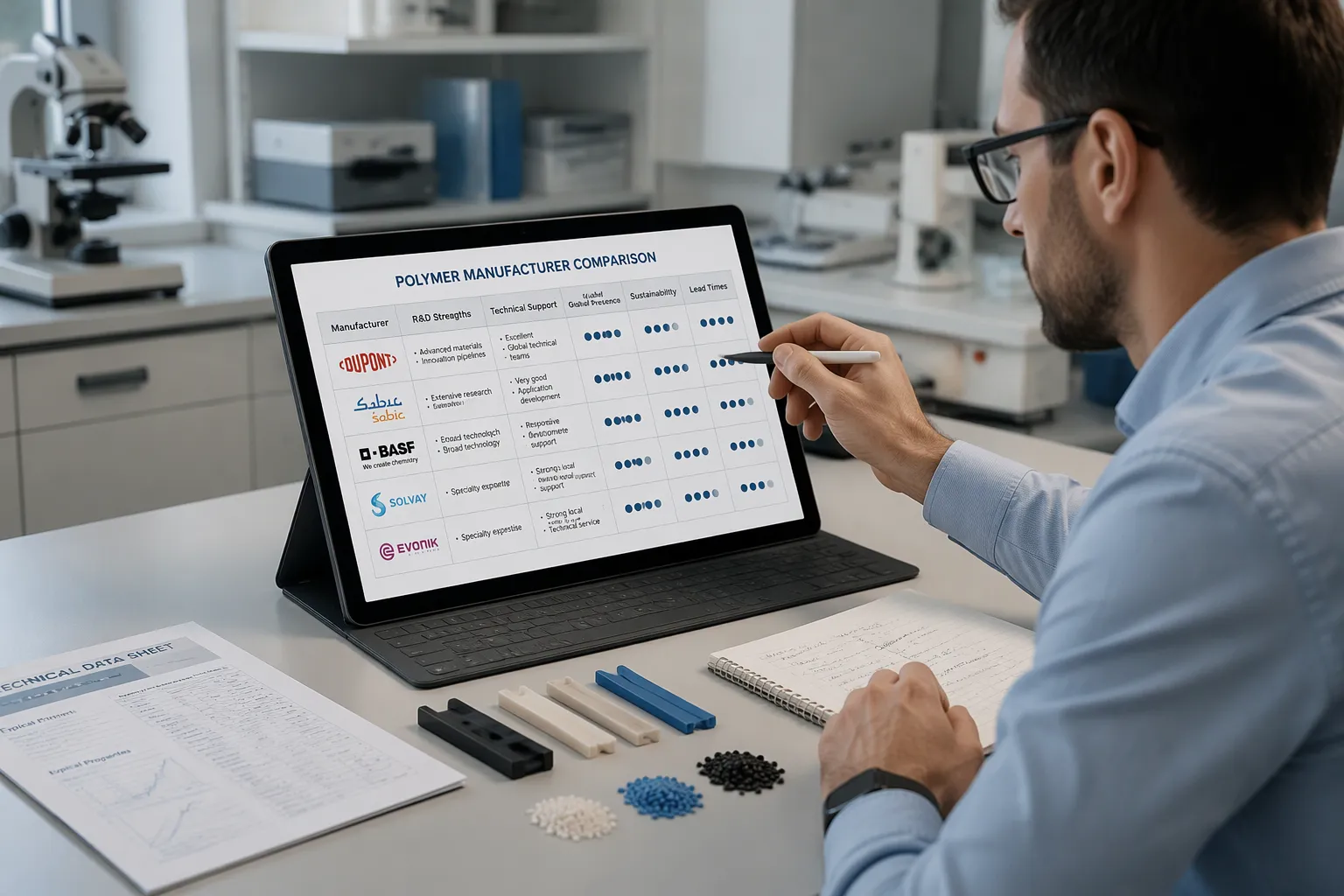
The table below sums up how each supplier compares on the points that matter most to technical buyers. It gives you a fast look before the detailed profiles that follow.
Manufacturer | R&D Strengths | Technical Support Strengths | Best-Fit Applications | Regulatory and Documentation Support |
|---|---|---|---|---|
DuPont | Applied innovation in semiconductor materials, water membranes, medical materials, and protective fibers | Joint development, long qualification cycles, application specialists | Electronics, water treatment, healthcare, safety | Change control and supply continuity for qualified parts |
BASF SE | About €2 billion in annual R&D, roughly 10,000 R&D employees, over 1,000 new patents in 2024 | Certified polyols, global technical service, application development | Automotive, agriculture, industrial coatings | Broad compliance packages and safety data |
Dow | Application-led innovation in packaging, mobility, infrastructure, and electronics | On-site and off-site support, ASTM/ISO/EN/DIN lab testing, training | Packaging, adhesives, coatings, construction | Technical data sheets, safety data sheets, certification packages |
Evonik | Polyamide and additive research, pilot-scale processing | Benchmarking, 3D-printed samples, formulation co-development | Sports goods, consumer goods, coatings | ISO and ASTM test documentation |
Arkema | 17 R&D centers, 1,800 researchers, 3.1% of sales to R&D | Five solution-oriented research platforms, startup program | Lightweight materials, new energies, electronics | Analytical and systems research reports |
LG Chem | Amide-functional polymer systems, polycarbonate capacity at Yeosu | Regional application engineering, cost-effective production | Automotive components, consumer electronics | Regional market documentation |
LyondellBasell | Polyolefin heritage, Cincinnati Technology Center | Material selection, process optimization, training, troubleshooting | Advanced thermoplastics, composites, masterbatches | REACH compliance support |
Covestro | Polymeric biomaterials research | Application development for medical and industrial uses | Healthcare, industrial parts | Material compliance documentation |
3M | Modeling and simulation, analytical sciences, polymer science | Customer support tools, accelerated weathering, application engineering | Flexible electronics, displays, filtration | Registration support through commercialization |
Polysikon, Super Dragon, Polysailing, Polysylene, Polysesle | In-house compounding, custom formulation, impact and flame testing | Design review, gate location advice, processing settings | Paint-free appliances, automotive, robotics, ESD electronics, agriculture | ISO 9001:2015, IEC 61340 compliance |
Evaluation Criteria
Buyers should rate each polymer manufacturer on seven factors. Innovation and patents show whether a supplier creates new chemistry or just licenses it. BASF SE, for example, reported over 1,000 new patents worldwide in 2024, and about 45 percent were tied to sustainability. Testing facilities show how fast a supplier can validate a formulation. Evonik runs pilot-scale plastics processing and supplies 3D-printed samples for early validation.
Application engineering and custom formulation decide how well a material fits a specific part. The specialty brand family studies working conditions, selects the polymer base and additive package, then adjusts melt flow rate and viscosity to match the process. Troubleshooting responsiveness matters when production lines stall. LyondellBasell lists troubleshooting and process optimization among its support services. Regulatory compliance and cost close the list. Arkema devotes 3.1 percent of sales to R&D across 17 centers, so buyers pay for that depth in the price.
R&D Capabilities Compared
Comparing Polymer Manufacturer R&D
Innovation output tells polymer suppliers apart more clearly than catalog size does. Patent records give one solid measure. PatSnap's thermoplastic composite matrix landscape shows Arkema France SA leading with 94 patent records, more than four times the second-ranked Cytec Industries at 20. The top five filers hold 45 percent of the hundred largest filers' combined total. Arkema focuses on condensation polymers, polyamide-based compositions, and composite processing. The chart below, published by PatSnap, ranks the top 20 applicants.
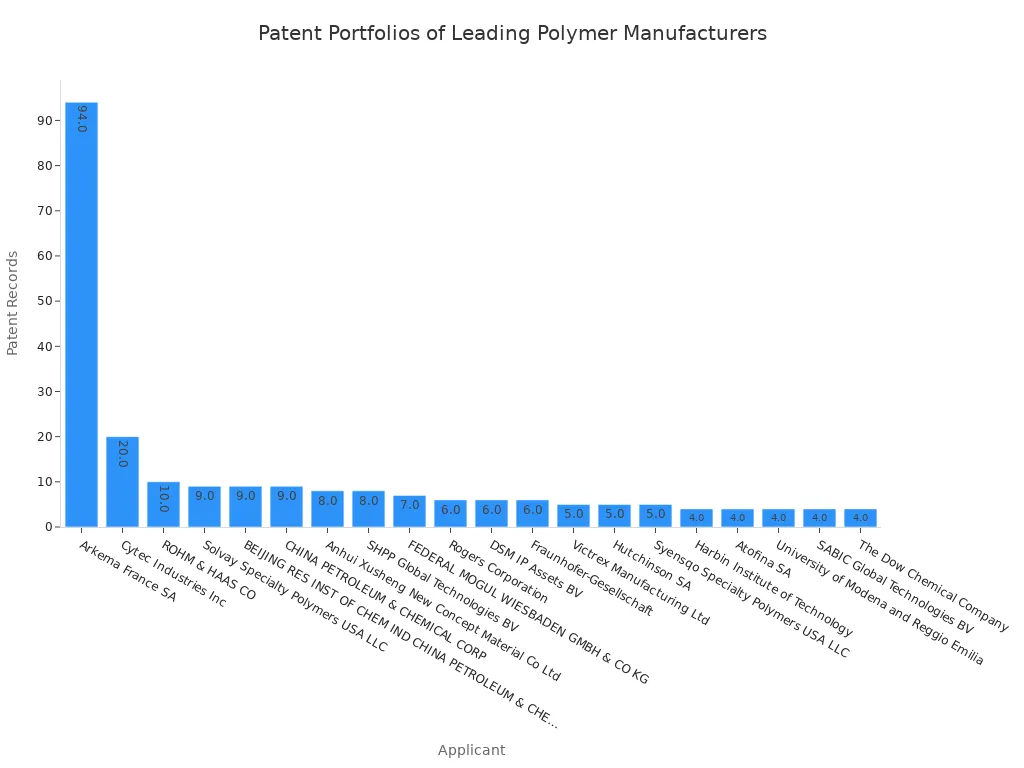
Arkema supports that portfolio with 17 R&D centers, 1,800 researchers, and 3.1 percent of revenue spent on R&D, according to Arkema. The company filed more than 200 new patents in 2025, and more than 90 percent relate to sustainable development. DuPont takes a different path. It builds tech-based solutions around high-performance plastics for semiconductors, water membranes, medical materials, and protective fibers. BASF SE pairs scale with breadth. It reported over 1,000 new patents in 2024, with about 45 percent tied to sustainability.
Biobased additives form another battleground. Research and Markets names Dow, Evonik, and Arkema as leaders. Dow combines biobased feedstocks with additive chemistry across polyethylene, polypropylene, and emerging biopolymers. Evonik uses bio-catalytic and fermentation techniques for green plasticizers, processing aids, and fillers. Arkema supplies halogen-free flame retardants and nature-based plasticizers, backed by bio-refinery investments.
Innovation and Testing Facilities
Production scale and testing depth tell the rest of the story. LG Chem ranks among the top polymer production factories, with polycarbonate capacity at Yeosu. LyondellBasell offers advanced polymers, thermoplastics, engineered solutions, composites, and masterbatches. Its engineered polymers cover blends and alloys such as PA/PPO, PBT/PC, and PC/ABS, plus flame retardant compounds certified to UL standards. Covestro and Corbion focus on polymeric biomaterials. 3M applies materials, process, and manufacturing capabilities to flexible electronics, displays, and filtration.
Digital tooling now shapes R&D speed. Polymerize Labs offers 35 or more domain-guided AI models that predict material properties and optimize formulations, with confidence scores and historical precedents attached to each recommendation. Its platform also acts as a system of record for experimental data, keeping results traceable and reusable.
The specialty brand family shows application-driven R&D across a wide product range. Polysikon covers paint-free materials. Super Dragon spans engineering, agricultural, smart appliance, and special materials. Polysailing serves robotics and automotive. Polysylene delivers thermoplastic elastomers. Polysesle handles electronic and electrical materials. Each line reflects compounding, custom formulation, and impact and flame testing tuned to a specific industry.
Technical Support Compared
Application Engineering and Troubleshooting
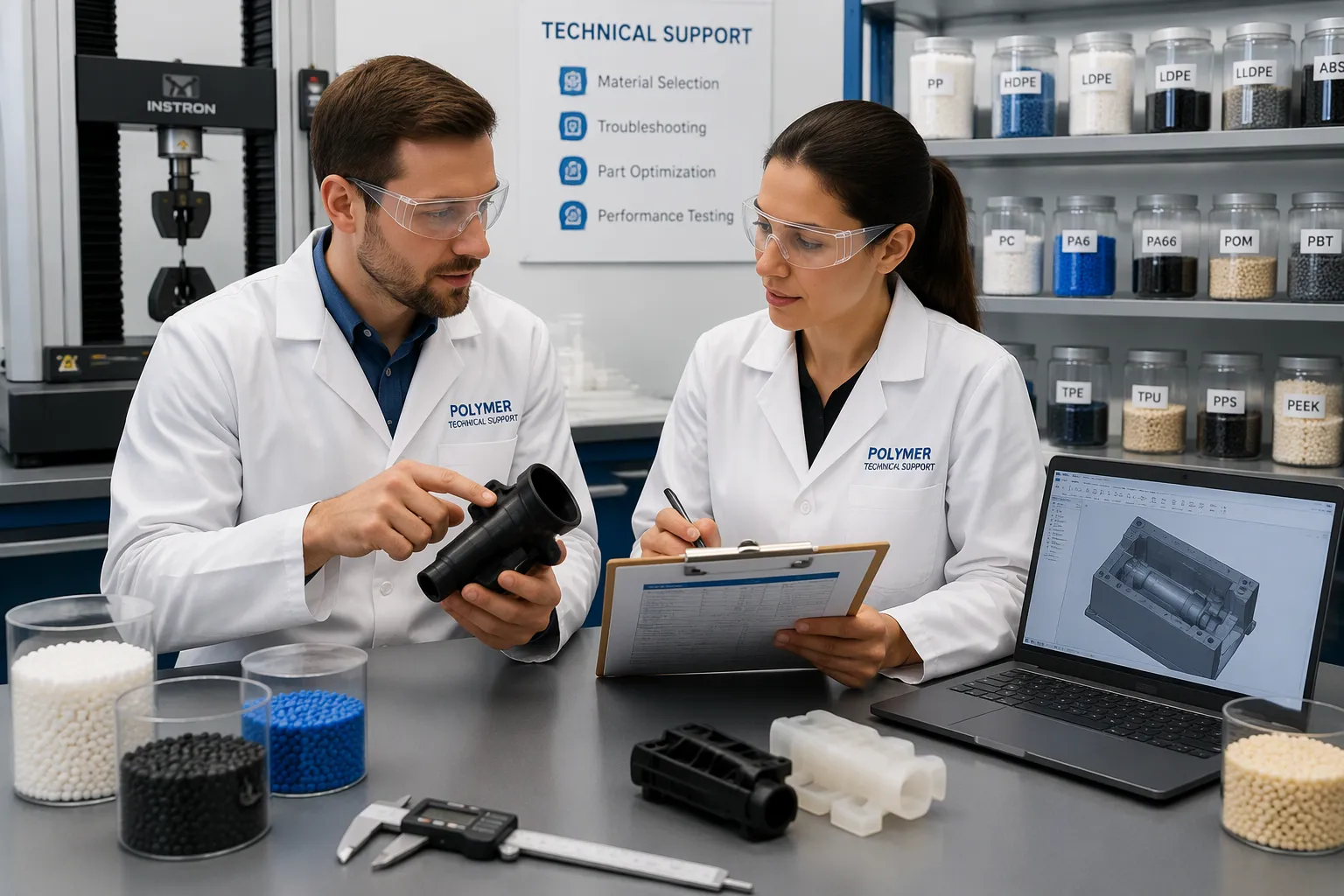
Technical support is what sets polymer suppliers apart once a part goes from drawing to production. Application engineers help with resin selection, mold design, processing settings, and failure analysis. M. Holland, a resin distributor, describes its technical services this way:
Consultations: From concept to commercialization
Plastic Resin: Selections and evaluations
Training: In polymer, extrusion, and molding
Optimizations: For all methods and processes
Development and Design: Of applications, tools, and parts
On-Location: Problem solving and troubleshooting
Technical Services Laboratory: Laboratory tests and analysis; Polymer characterization and identification; Sample performance testing; Failure analysis
That list shows the range a buyer should expect. In-house engineers at distributors and manufacturers focus on application development, plastic resin selection, mold design, and troubleshooting.
Large producers hire people for similar roles. An ExxonMobil polymers engineer job posting describes the work as solving small to medium technology problems in polymerization and finishing. The role also supports major projects and turnarounds, and leads structured troubleshooting across teams. The specialty brand family fits best where a part needs custom compounding. Its teams review designs, advise on gate locations, and tune processing settings for paint-free, automotive, robotics, and ESD applications.
BASF SE stands out for certified polyols. Its Lupranol product family serves flexible foam, rigid foam, coatings, and elastomer markets. The company pairs that portfolio with advanced formulation laboratories, a strong global supply chain, and strict batch-to-batch quality consistency. BASF also states that its biomass balance polyether polyols, now produced in Geismar, keep the same specifications and processing characteristics as fossil-based grades. Stefan Doerr, BASF Senior Vice President, Monomers North America, said customers in sleep products, automotive, and CASE industries "can transition to these new solutions without any reformulation or process changes." That drop-in reliability suits high-end manufacturers that need certified polyols and long-term service.
Compliance and Documentation
Regulatory paperwork often decides whether a material ships. Documentation support varies widely, and buyers should match it to their market. The table below shows two documented approaches.
Manufacturer | Compliance Framework | Documentation Support | Standards Addressed |
|---|---|---|---|
Sumitomo Bakelite Co., Ltd. | Three-tier strategy covering chemical registration, food contact, and waste rules; tracks legislation in 35+ countries | Regulatory tracking systems; lifecycle assessment methods | REACH, TSCA, FDA, EU 10/2011, USDA BioPreferred |
Bezwada Biomedical LLC | Design for Regulatory Compliance from the chemistry stage; early talks with authorities | Records the full regulatory history of each monomer and catalyst | FDA and EMA guidelines |
Other suppliers take narrower paths. DuPont offers change control and supply continuity for qualified parts. Dow supplies technical data sheets, safety data sheets, and certification packages. LyondellBasell provides REACH compliance support. The specialty brand family holds ISO 9001:2015 and meets IEC 61340 for ESD electronics. Each polymer manufacturer fits a different compliance profile, so buyers should confirm the certificates their own market requires before committing.
How to Evaluate a Polymer Manufacturer
Performance, Fit, and Cost
A good evaluation starts with the part, not the catalog. The engineering design process looks at the whole life of a component. That includes its function, how easy it is to make, and economic and environmental factors, according to research published in PMC. Buyers should define the process first — blow molding, film extrusion, or injection molding. Each one needs a grade with specific melt flow, density, and strength characteristics. A wrong grade leads to uneven results, production delays, or product defects.
Four factors then guide the decision:
Technical performance: check the maximum service temperature, thermal aging tolerance, and radiation resistance where relevant. PMC notes that thermal aging life can follow activation energies set by EPRI TR 1009748.
Application fit: confirm melt flow index, density, and additives such as UV stabilizers and antioxidants match the process.
Regulatory compliance: ask for a Certificate of Analysis for every batch. It should cover melt flow rate, density, tensile strength, and environmental stress crack resistance.
Cost: compare quoted prices across suppliers. Confirm whether logistics, duties, and handling charges are included.
The cheapest option rarely gives consistent results. A polymer manufacturer that balances price with grade compatibility and reliability usually lowers total maintenance costs over time.
Matching Support to Your Needs
A practical checklist turns these factors into a decision. First, check R&D facilities and patent records. Second, ask for samples and batch test data before full-scale production. Third, judge application engineering responsiveness — how fast engineers answer processing questions and visit the line. Fourth, confirm documentation and compliance support for the target market.
Each supplier fits a different need. DuPont and BASF SE suit high-end certified programs with long qualification cycles. LyondellBasell fits advanced thermoplastics, composites, and masterbatches. Covestro serves biomaterials, while 3M supports electronics and displays. The specialty brand family — Polysikon, Super Dragon, Polysailing, Polysylene, and Polysesle — fits custom compounding for paint-free, automotive, robotics, and ESD parts. Buyers should also test color samples before production, since pigments can shift melt flow and thermal properties.
BASF SE gives the best overall blend of R&D size and technical support. It combines about €2 billion in yearly R&D and over 1,000 new patents in 2024 with certified polyols and global service. DuPont and Arkema work well for high-end programs that take a long time to qualify. LyondellBasell fits advanced thermoplastics and masterbatches. Covestro serves biomaterials, and 3M supports electronics. The specialty brand family covers custom compounding for paint-free, automotive, robotics, and ESD parts.
Buyers should weigh four factors before they choose a polymer manufacturer. Technical performance and application fit come first. Regulatory compliance and cost come next. Ask for samples and batch test data, then judge how fast application engineers respond.
FAQ
Which polymer manufacturer spends the most on R&D?
BASF SE reports about €2 billion in yearly R&D spending and roughly 10,000 R&D employees. That scale supports over 1,000 new patents in 2024. Arkema takes a different route. It puts 3.1 percent of sales into R&D across 17 centers and 1,800 researchers.
How quickly can a buyer get test samples?
Speed depends on the supplier's testing setup. Evonik runs pilot-scale plastics processing and supplies 3D-printed samples for early validation. Dow offers ASTM, ISO, EN, and DIN lab testing at its own facilities. Buyers should ask for batch test data along with any sample before full-scale production.
Which suppliers support ESD and electronics applications?
3M supports flexible electronics, displays, and filtration through modeling, simulation, and analytical sciences. Polysesle covers electronic and electrical materials within the specialty brand family. That family holds ISO 9001:2015 and meets IEC 61340 for ESD parts. DuPont also serves semiconductor and electronics programs.
What documentation should a buyer request?
Ask for a Certificate of Analysis covering melt flow rate, density, tensile strength, and environmental stress crack resistance. Confirm the compliance framework matches the target market. DuPont offers change control for qualified parts, Dow supplies certification packages, and LyondellBasell provides REACH compliance support.
Which manufacturer fits custom compounding best?
The specialty brand family fits custom compounding work. Polysikon covers paint-free materials, Polysailing serves robotics and automotive, and Polysylene delivers thermoplastic elastomers. Its teams review designs, advise on gate locations, and tune processing settings. Large producers such as LyondellBasell fit advanced thermoplastics and masterbatches instead.