

A reliable functional masterbatch manufacturer earns that status through verified technical capability, documented quality assurance, dependable supply, and cost-effectiveness. Directory listings alone reveal none of these strengths. Buyers who choose on listings alone risk weak additive performance, inconsistent color or properties, and costly line stoppages.
Functional masterbatch selection directly shapes end-product performance. A poor additive package can dull flame resistance, weaken UV stability, or shift mechanical properties beyond specification. This post gives buyers a practical framework: sourcing channels, evaluation criteria, testing methods, cost analysis, and a selection checklist for qualifying a reliable functional masterbatch manufacturer.
Key Takeaways
Before you buy, check the manufacturer's technical skills and quality records.
Run test samples on your own production line to check how well they work.
Compare the full costs, not just the price for each kilogram.
Check that your supplier can deliver on time and has the right papers for your market.
Use a checklist to check suppliers and avoid common problems.
What Is Functional Masterbatch?
Definition and Common Types
A functional masterbatch is a strong mix of additives that a maker spreads into a carrier resin. Processors add this mix to a base polymer at a low let-down ratio. The additive then gives a specific performance property all through the finished part. The carrier resin must match the host polymer well. Poor carrier choice causes dispersion problems and surface defects.
Common functional types serve different purposes. Flame-retardant masterbatches slow ignition and limit flame spread. UV stabilizer masterbatches protect outdoor parts from sunlight damage. Antioxidant grades make service life longer in hot or oxidative environments. Antistatic masterbatches control surface resistivity for electronics and packaging. Processing-aid masterbatches improve melt flow and mold release. Each type has its own active chemistry and its own handling needs.
Key Performance Requirements
Dispersion quality ranks as the first requirement. Undispersed additive agglomerates create weak spots, visible defects, and inconsistent properties across a production run. A reliable manufacturer controls agglomerate size and checks dispersion under production conditions.
Carrier compatibility comes next. The carrier must bond with the host polymer without phase separation. Buyers should confirm the carrier resin matches their base material before they commit to a trial.
Additive loading and thermal stability also matter. The concentrate must hold its active content through compounding and molding temperatures. Degradation during processing wastes additive and shifts final properties. Consistency across lots completes the list. Each shipment should deliver the same active content and the same dispersion behavior. Lot-to-lot variation forces processors to adjust settings again and again and raises scrap rates.
Where to Source Reliable Suppliers
Buying from around the world lets buyers get reliable raw materials, fair prices, and steady quality from different regions. Searching widely also means you don't depend on just one market. Buyers who look at several regions often find better technical help and steadier supply than a local-only search gives.
Industry Directories and Rankings
Industry directories are a good place to start. Sites like Thomasnet list manufacturers by what they can do, where they are, and what they make. Buyers can filter for functional masterbatch suppliers and make a short list for a closer look.
Supplier rankings and top-ten lists add another layer. These lists often show production size, export experience, or market reputation. Buyers should use rankings as a first check, not a final answer. A high rank shows visibility, not proven quality. Check each name against technical documents and sample results before you commit.
Regional Sourcing Hubs
China has a large group of masterbatch makers with many additive products and strong export shipping. Buyers who want a wide product range and competitive prices often start there. Vietnam has grown as another hub with rising production capacity and good trade access. It suits buyers who want sourcing options outside a single country. The USA offers suppliers with mature quality systems and short domestic lead times. It fits buyers who care most about fast response and local technical service.
Each hub fits a different sourcing plan. A buyer may mix regions to balance cost, lead time, and risk. The right mix depends on order volume, technical needs, and delivery targets. Regional fit matters more than country labels alone.
How to Find a Reliable Functional Masterbatch Manufacturer
Technical Expertise
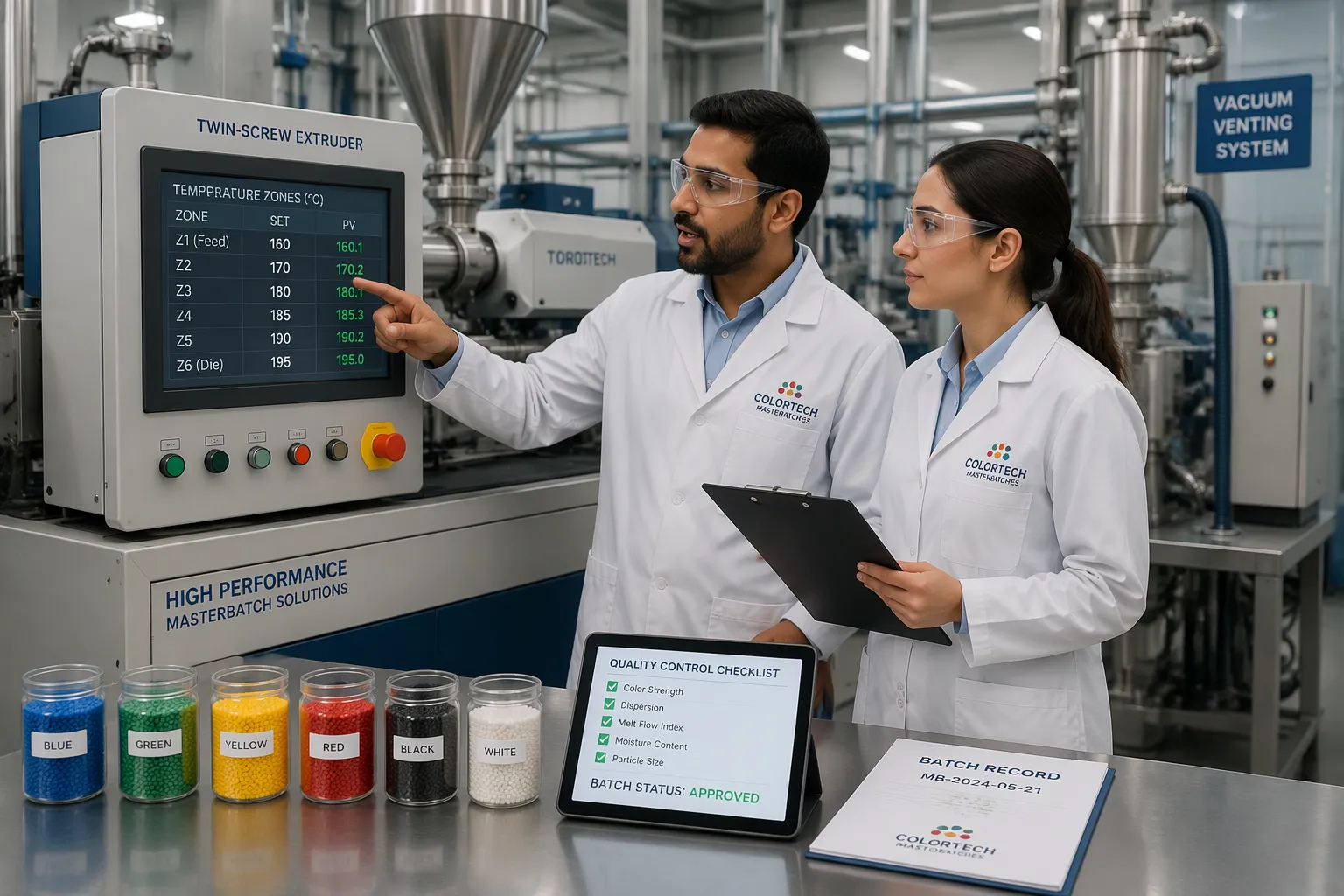
Technical know-how is what sets a capable supplier apart from a catalog reseller. Buyers should look at the production equipment behind the product. Extrusion control systems say a lot about a plant's real capability. Modern systems use PID algorithms and solid-state heating and cooling to hold temperature accuracy within plus or minus one degree Celsius, according to Kerkee Extruder. Zone-based control lets operators set stepped temperature profiles that match each formulation. The number of controllable zones and the precision of adjustment show whether equipment is strong or weak.
Technical Capability | What Buyers Should Evaluate |
|---|---|
Temperature control | Zone-based profiles with accuracy within plus or minus one degree Celsius |
Screw design | Modular elements and kneading blocks for dispersive mixing; lower compression ratios for heat-sensitive additives |
Throughput flexibility | Turndown ratios of ten to one or greater across batch sizes |
Vacuum venting | Removal of volatiles and reaction byproducts that harm functional performance |
Formulation knowledge matters just as much as hardware. Mundhra Masterbatch notes that a manufacturer should understand how additive selection, carrier resin compatibility, processing conditions, and end use connect. Buyers can test this understanding with direct questions. Ask why a specific carrier suits the base polymer. Ask how the let-down ratio affects dispersion. Strong answers show real experience. Weak answers reveal a supplier who simply resells compounds.
Consistency and Documentation
Consistency is what sets a reliable functional masterbatch manufacturer apart from one that delivers a good first batch and poor later ones. Buyers should ask how the plant controls batch quality. Mundhra Masterbatch recommends checking testing procedures, batch consistency practices, technical specifications, and traceability. A strong quality system covers raw material inspection, in-process monitoring, final product testing, documented acceptance criteria, and traceability. Testing the masterbatch in the actual base polymer under real processing conditions gives more useful information than pellet-level inspection alone.
Documentation proves that consistency exists. Kerkee Extruder lists the records a buyer should request: material traceability, process parameter records, quality test results, and test reports that clearly identify samples, test methods, results, and conformance to specifications. Detailed records of processing conditions, material lots, and quality results add further proof. Buyers should review these documents before placing orders. Missing records signal a weak quality system. Complete records show a supplier that can repeat performance across shipments.
Support and Compliance
Technical Service and Trials
Good technical support is what makes a manufacturer different from a company that just sells compounds. Americhem lists a full set of services: analytical testing for performance and quality assurance, product design help for function and manufacturability, custom manufacturing built around the buyer's formulation, and customer process simulation that copies real-world processing to lower development risk. Field services add on-site help for trials, troubleshooting, and optimization.
Trial capability matters just as much. Kerkee Extruder notes that factory trial programs let buyers test formulations on production-scale compounding extruder systems before they commit to equipment. Process development support helps buyers fine-tune formulations and processing conditions. Technical support then keeps going through installation, commissioning, and ongoing operation, with maintenance guidance and continuous improvement help. Buyers should make sure these services are in place before they sign, because weak support turns a small processing issue into a long stoppage.
Compliance Documentation
Compliance paperwork shows that a supplier can serve regulated markets. Coace Chemical lists the core documents buyers should ask for:
Certification / Document | What It Confirms | Buyer Value |
|---|---|---|
SDS | Safety handling and hazard information | Workplace safety |
TDS | Technical properties and usage guidance | Formulation reference |
COA | Batch-specific quality data | Incoming inspection |
REACH / SVHC | EU chemical compliance | Export risk control |
RoHS | Restricted substances control | Electronics and brand compliance |
PAH / Phthalate report | Restricted substance safety | Footwear, rubber, consumer products |
Food-contact data | Packaging suitability | Food packaging compliance |
UL-related data | Flame retardant or electrical performance | Cable/electronics projects |
Food-contact work needs extra care. Strategic Market Research explains that the concentrate itself does not get blanket approval. The pigments, additives, and carrier system must fit the intended contact conditions and support downstream compliance. In the United States, FDA handles colorants for food-contact polymers under 21 CFR 178.3297. In the European Union, Regulation (EU) No. 10/2011 sets the rules for plastics meant to touch food. These frameworks make locked formulations, migration documentation, and change-control discipline more valuable. Buyers in packaging and other regulated fields should confirm that each document covers their exact grade and end use.
Evaluating and Comparing Manufacturers
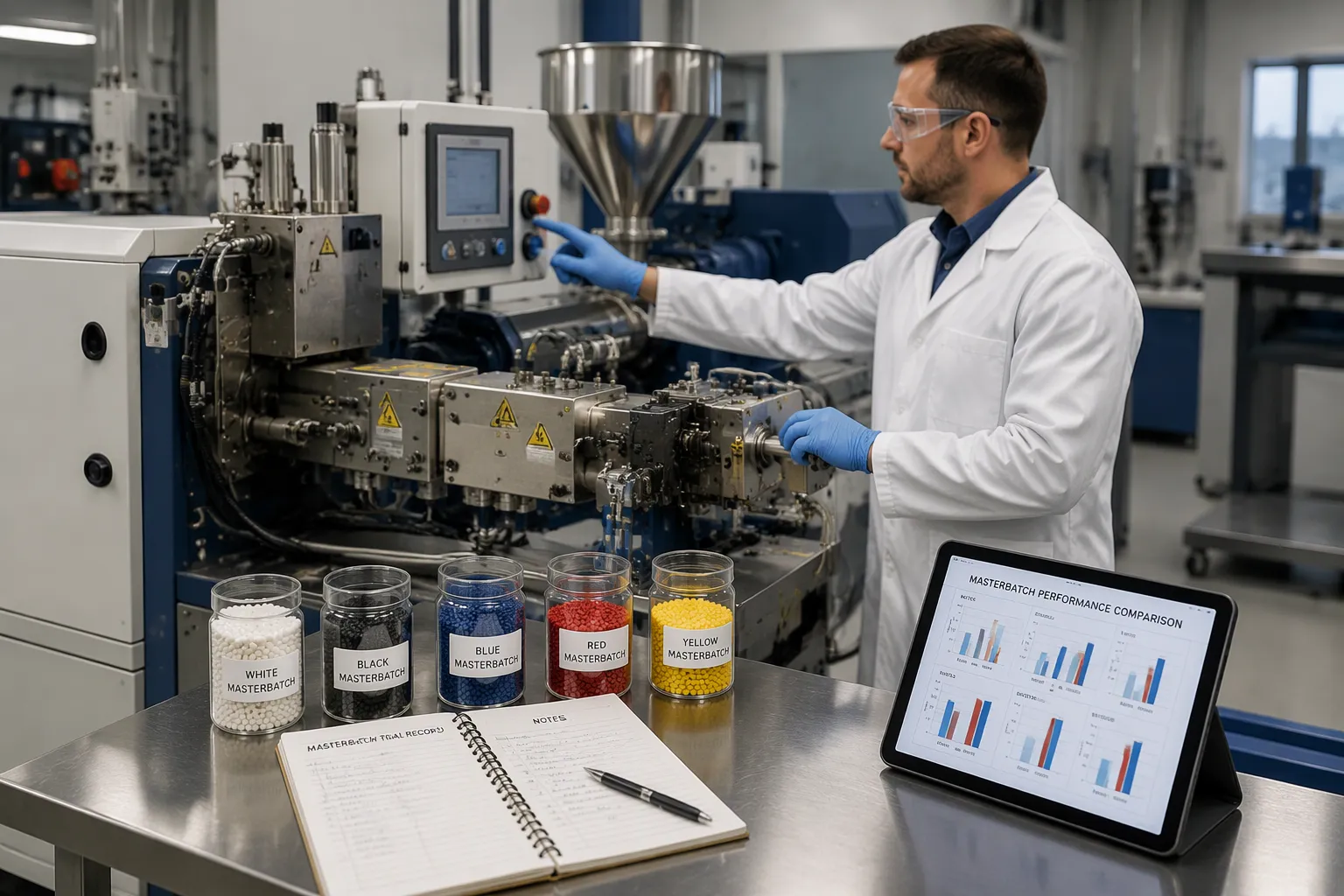
Buyers need a clear, organized comparison to tell strong suppliers apart from weak ones. Mascom Global lists the factors that matter most: additive concentration and let-down ratio, dispersion quality, carrier resin compatibility, UV and weathering data, mechanical and electrical effects, quality assurance documents, supply reliability, and recycled-polymer compatibility. Each factor connects to real results in production. A low let-down ratio with weak dispersion raises the cost per finished part. A carrier that does not match the base polymer causes phase separation and surface defects.
Samples and Performance Testing
Sample trials are the basis for a shortlist. Buyers should test with the production resin and a part shape that represents the real part. Cavity Mold recommends writing down drying, melt and mold temperatures, screw speed, back pressure, residence time, dosage, and inspection method. These records turn a trial into evidence. A short trial that works is useful, but it does not prove long-term performance or compliance with every application requirement.
Zhongfuhai advises keeping two comparisons separate. A technical comparison tests all samples the same way, at the same final additive content in the part, on the same machine. An application comparison runs each supplier's product at its own recommended addition ratio to compare practical results and cost in use. Buyers should record which comparison they made. Supplier test conditions often differ, so their data cannot be compared directly.
Item | Purpose | Requirements |
|---|---|---|
Processing trial | Performance in the intended process | Controlled, documented conditions |
Processing trial record | Documents performance under stated production conditions | Materials, settings, results and acceptance decision |
Audits and Reference Checks
Audits check what samples cannot show. Charming Masterbatch recommends auditing twin-screw compounding capability, CoA documentation on inbound shipments, and standard deviation charts that show long-term production stability. A facility audit should confirm lab equipment such as spectrophotometers, lab-scale extruders, moisture analyzers, and melt flow indexers. Process automation matters too: gravimetric dosing systems, automated pelletizing lines, and dust extraction all support steady output.
Dispersion proof deserves special attention. Charming Masterbatch advises demanding pressure filter value test reports run under DIN EN 13900-5. That test pushes molten compound through a fine wire mesh filter, usually 14 to 25 microns, and measures the pressure rise over time. For color-critical work, buyers should require digital spectrophotometer readings for every lot. Charming Masterbatch sets color variation at ΔE ≤ 0.5 under D65 lighting for critical exterior automotive or consumer electronics applications.
Reference checks complete the picture. Buyers should ask shortlisted suppliers for contact details of existing customers in similar applications. A reliable functional masterbatch manufacturer will share references without hesitation. Vague answers or refused references signal risk. Buyers should also confirm that regulatory documents such as RoHS 3, REACH SVHC, and FDA food-contact compliance cover the exact grade under review.
Cost Beyond Price
Total Cost of Ownership
The price per kilogram is only one part of the cost. Total cost of ownership also includes the work to qualify a supplier, trial runs, the cost of holding inventory, and the risk of line stoppages. Verified Market Research notes that gaps in performance qualification across polymer, processing conditions, and target appearance create costly trial-and-error barriers. Each trial uses up resin, machine time, and lab hours. Those costs fall on the buyer, not on the supplier's invoice.
Several hidden cost drivers should be part of every comparison:
The time to requalify when a supplier or formulation changes
Safety stock and rush freight that guard against delivery gaps
Scrap and rework caused by lot-to-lot variation
Paperwork and testing required for regulated end uses
Verified Market Research also reports that high raw-material price swings make buyers less willing to lock in long-term supply. Buyers then order more often in smaller amounts. That pattern adds logistics and contracting friction, and it pushes total cost up even when the unit price looks flat.
Cost vs. Performance and Risk
A low price comes with its own risk. Verified Market Research explains that masterbatch performance depends on dispersion quality, polymer compatibility, and sensitivity to melt temperature and residence time. A cheap grade that disperses poorly forces higher addition rates, so the apparent saving disappears in the finished part. Buyers should compare cost at equal performance, not cost per bag.
Risk adds to the calculation. Regulatory pressure raises testing, reporting, and formulation limits for pigments, additives, and carrier resins, according to Verified Market Research. Compliance work adds verification costs and can slow adoption. Verified Market Research further describes a practical tradeoff between responsiveness and cost, where buyers weigh shorter replenishment windows against rush logistics and changeover expense. A slightly higher-priced supplier with stable quality and complete documents often costs less over a year than a bargain supplier that causes rework, late deliveries, and repeated trials.
Supply Chain Reliability
Lead Times and Capacity
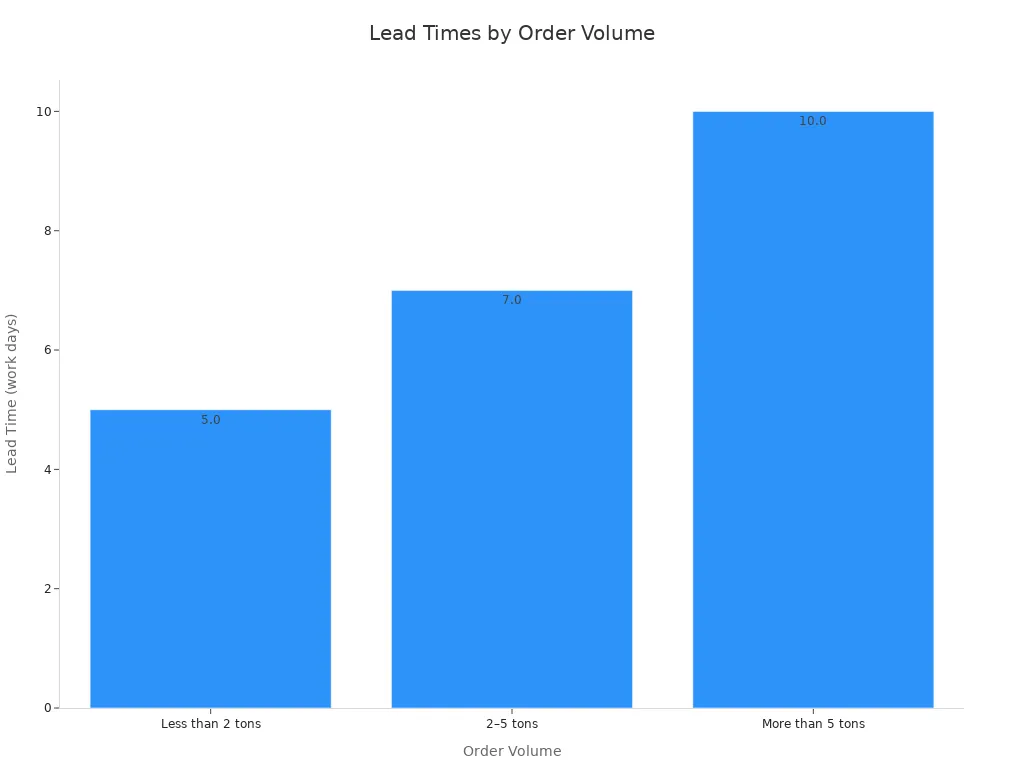
Delivery timing affects production planning just as much as product quality does. Lead times change a lot depending on the order type and formulation. MHK Color reports that standard colors ship in 3–7 days, custom colors take 7–15 days including color matching and approval, and reorders of approved colors often go back to 3–7 days. Accio cites 7 to 14 business days for common formulations and up to 21 days or more for complex custom work. STDPoly links timing to volume: orders under 2 tons take 5 work days, 2–5 tons take 7 work days, and orders above 5 tons take about 10 work days or more.
Buyers should ask each supplier for promised lead times at their own order volume, not catalog averages. Capacity checks matter too. A plant that runs near full load cannot handle a demand spike or a rush reorder. Buyers can ask for production schedules and confirm how the supplier handles peak seasons.
Responsiveness and Partnership
Responsiveness is what separates a manufacturing partner from a broker. Ascent Petrochem describes suppliers that treat client production-line feedback as valuable input. Frequent site visits uncover recipe improvements and give operators ongoing support. Quick communication and fast hands-on help reduce downtime when trouble arises.
Strong partners also offer custom development and direct R&D support. Ascent Petrochem notes that facilities regularly develop custom shades and response temperatures per client specifications, such as activation at 15°C for smart labels and 38°C for hot-fill containers. Application labs troubleshoot processing issues before mass scale-up, and technologists help operators dial in screw settings and resin ratios during plant audits. Process transparency rounds out the picture: the supplier shares full technical dossiers and invites customer teams to watch live batch production. A LinkedIn analysis of the transparent color masterbatch market notes that Tosaf prioritizes customer collaboration and market responsiveness, while Astra Polymers relies on localized production for quick responses to market demands. Buyers should test these traits early with a small request and watch how fast and how completely the supplier answers.
Buyer Selection Checklist
Technical and Quality Items
A clear checklist helps you compare suppliers the same way every time, instead of relying on scattered impressions. Zhongfuhai lists six checks that show which suppliers are strong and which are weak. The table below sums up what each check should give you.
Check | What a reliable supplier provides |
|---|---|
Dispersion | A tested dispersion rating plus a film or chip sample you can look at yourself |
Compliance | Dated third-party SGS reports tied to a specific product code |
Consistency | Direct manufacturing rather than trading, with process control for raw material drift |
Application fit | A carrier matched to your resin and a real grade range |
Samples | A sample and TDS for a line trial before you commit to any volume |
Pricing | A price the supplier can explain, not just the lowest number |
Buyers should also confirm carrier resin compatibility, additive content control, and stable processing behavior. Nuoxinplastic notes that a trial should check dispersion, color consistency, processing stability, surface appearance, and any shift in mechanical properties. Compliance paperwork deserves equal weight. Buyers should request EU RoHS (EU) 2015/863, REACH SVHC screening, and FDA or GB food-contact data where the end use demands it.
Commercial and Supply Items
Commercial checks protect the buyer after the technical decision is made. Buyers should ask for promised lead times at their own order volume, not catalog averages. They should confirm plant capacity during peak seasons and request customer references in similar applications. A reliable functional masterbatch manufacturer shares these details without hesitation.
Payment terms, minimum order quantities, and change-control policies complete the list. Buyers should confirm how the supplier handles formulation changes and who bears requalification costs. Clear answers on these points reduce friction later and keep the supply relationship stable.
Qualifying a Reliable Functional Masterbatch Manufacturer
Final Verification Steps
The last stage turns a shortlist into a decision. Buyers should make sure every document matches the exact grade they are reviewing. A certificate for a sister product proves nothing about the batch on order. Ask for the SDS, TDS, and COA for the specific product code. Then check that the COA data falls inside the TDS limits. Any mismatch between the two documents deserves a direct question before approval.
A final plant visit or video audit closes the remaining gaps. Buyers should watch the compounding line run and confirm the gravimetric dosing system is active. They should also review the pressure filter value report run under DIN EN 13900-5. For color-critical work, ask for the latest spectrophotometer readings. Confirm they sit at or below ΔE ≤ 0.5 under D65 lighting. A supplier that produces these records on the spot has nothing to hide.
Approve the supplier only after the trial part, the documents, and the audit all agree. One strong result cannot cover a weak one.
Common Pitfalls to Avoid
Buyers stumble most often on price-led shortcuts. A quote far below the market usually hides a weaker additive package, a mismatched carrier, or thin quality control. The saving vanishes once scrap rises or addition rates climb. Buyers should compare cost at equal performance. They should also treat an unexplained low price as a warning sign.
A second pitfall is trusting catalog lead times. Published figures of 3–7 days often apply to standard colors only. Custom formulations take longer, and peak seasons stretch every promise. Buyers should lock in written lead times at their own order volume. They should also confirm capacity headroom.
A third trap is skipping reference checks. Suppliers who refuse to share customer contacts in similar applications rarely deserve a purchase order. A reliable functional masterbatch manufacturer answers these requests without delay. Buyers who verify references, documents, and trial data before signing avoid most qualification failures.
A directory listing never makes a supplier reliable. Buyers confirm reliability by checking where they source, testing technical skills, reviewing quality records, running trials, analyzing cost, and checking the supply chain. Each step proves a different strength, and one good result cannot cover the others.
Buyers should use the checklist as a vendor qualification process they can repeat, not a one-time comparison. A simple next step is to ask each shortlisted manufacturer for samples and quality documents. A reliable functional masterbatch manufacturer answers both requests fast and fully. That response tells buyers more than any ranking can.
FAQ
How can a buyer verify dispersion claims without a full lab?
Ask for a pressure filter value report run under DIN EN 13900-5. Request a film or chip sample so you can look at it yourself. Run a trial on the production machine and check for agglomerates, surface defects, and property shifts. A supplier who supplies these items quickly shows real capability.
Can a trading company serve as a reliable supplier?
A trading company can work well when it holds direct manufacturing partnerships and controls quality documentation. Buyers should confirm who actually compounds the product. Ask for the plant name, audit access, and batch traceability. Direct manufacturing usually offers tighter process control and faster technical support.
How many manufacturers should a buyer shortlist?
Three to five suppliers give buyers enough comparison without overload. Each candidate should pass the document review first. Then run trials on the same resin and part shape. A shortlist of this size keeps trial costs manageable and still reveals differences in dispersion, consistency, and service.
What should a buyer do when documents and trial results disagree?
Treat the conflict as a stop signal. Ask the supplier to explain the gap in writing. Request a fresh COA for the exact batch and a repeat trial under documented conditions. Approve nothing until the documents, the trial part, and the audit all agree.
How should a buyer handle the first order?
Start with a small volume at the promised lead time. Record the actual delivery date and inspect the COA against the TDS limits. Run a short production trial and compare results with the sample batch. A clean first order builds the evidence for larger commitments.