


Five pillars separate reliable PEEK manufacturers from risky ones: quality systems, technical expertise, supply stability, compliance and traceability, and value. These criteria give buyers a clear framework for every candidate review.
PEEK's demanding performance profile raises the stakes. Parts must endure high heat, resist aggressive chemicals, and hold up under continuous wear. A weak supplier choice can quietly undermine all three. This guide offers a practical, checklist-style set of criteria. Buyers can apply each item to any candidate manufacturer and compare results on evidence, not sales claims.
Key Takeaways
Look for ISO 9001 and other industry certifications. Ask for batch test reports to show that quality stays the same.
Pick a supplier who knows PEEK well. They should help you choose the right grade and give advice on machining.
Ask for lead times and safety stock details in writing. A steady supply keeps production from being delayed.
Check that every lot can be traced from raw material to finished part. This protects you from recalls and disputes.
Compare the total cost of owning the parts, not just the price. PEEK parts often last longer and cut down on downtime.
Quality Assurance at PEEK Manufacturers

Quality assurance is what sets a serious PEEK supplier apart from a reseller with a catalog. Buyers should look at two layers of evidence. The first layer covers the certifications a manufacturer holds. The second layer covers the batch-level records the manufacturer can produce on demand. Both layers matter. A supplier may hold a certificate yet still ship inconsistent material. The review must connect the paperwork to the product.
Certifications That Matter
ISO 9001:2015 serves as the baseline quality management system certification. It shows a manufacturer documents its processes, trains its staff, and audits its own work on a schedule. Industry-specific standards go further and address sector risks. The table below maps common certifications to their sectors.
Industry | Certification / Standard | Scope / Notes |
|---|---|---|
Aerospace | AS9100D (2016) | Quality management system certified to worldwide aerospace requirements |
General quality | ISO 9001:2015 | Baseline quality management system certification |
Medical | ISO 10993-1 | Biological evaluation of medical devices; supplied upon request |
Medical | FDA Regulation 21 CFR 177.2415 | Food-contact and medical resin compliance; supplied upon request |
Oil and gas | Mil-P 46183 | PEEK resins meet this military specification |
Oil and gas / general | ASTM D6262 | PEEK stock shape products are compliant |
Aerospace buyers may also request Bell Helicopter 299-947-362 or BMS8-317 where applicable. Reliable PEEK manufacturers supply material certifications, quality assurance documentation, and traceability reports as standard practice. Buyers should request the certificate scope, not just the certificate number. The scope states which processes and sites the certification covers. A current certificate with a narrow scope tells a different story than an expired one with broad coverage.
Batch Consistency and Test Data
Grade choice determines which properties need verification. Unfilled PEEK demands checks on purity and thermal performance. A 30% carbon-fiber reinforced grade requires fiber content and dispersion checks. Wear grades need friction and wear-rate data. Each lot can drift, so the test plan must match the grade. A single generic test suite cannot cover every product family.
Buyers should request a certificate of analysis for every lot. A useful CoA lists the test method, the specification limit, and the measured result for each property. The CoA should carry actual measured values, not a copy of a generic datasheet. Lot-specific test data reveals real batch behavior. Generic datasheets describe typical values and hide variation. A supplier who cannot produce lot-level records cannot prove consistency. That gap matters most in demanding applications, where small property shifts can trigger field failures.
Suppliers who track statistical process control data can show whether a process stays centered or drifts over time. That trend view adds confidence beyond a single passing lot. Ask three questions during evaluation. Does the CoA trace to a specific production lot? Which tests does the manufacturer run on every batch versus periodically? Can the supplier share historical data across several lots? Strong answers show a controlled process. Weak answers suggest the quality system exists on paper only. Buyers who compare PEEK manufacturers on these answers gain a clear view of real capability. The strongest suppliers welcome a plant audit and a sample request before any purchase order.
Quality assurance at PEEK manufacturers ultimately rests on evidence. Certifications open the door. Batch data proves the claim.
Technical Expertise and Support
Material Knowledge and Grades
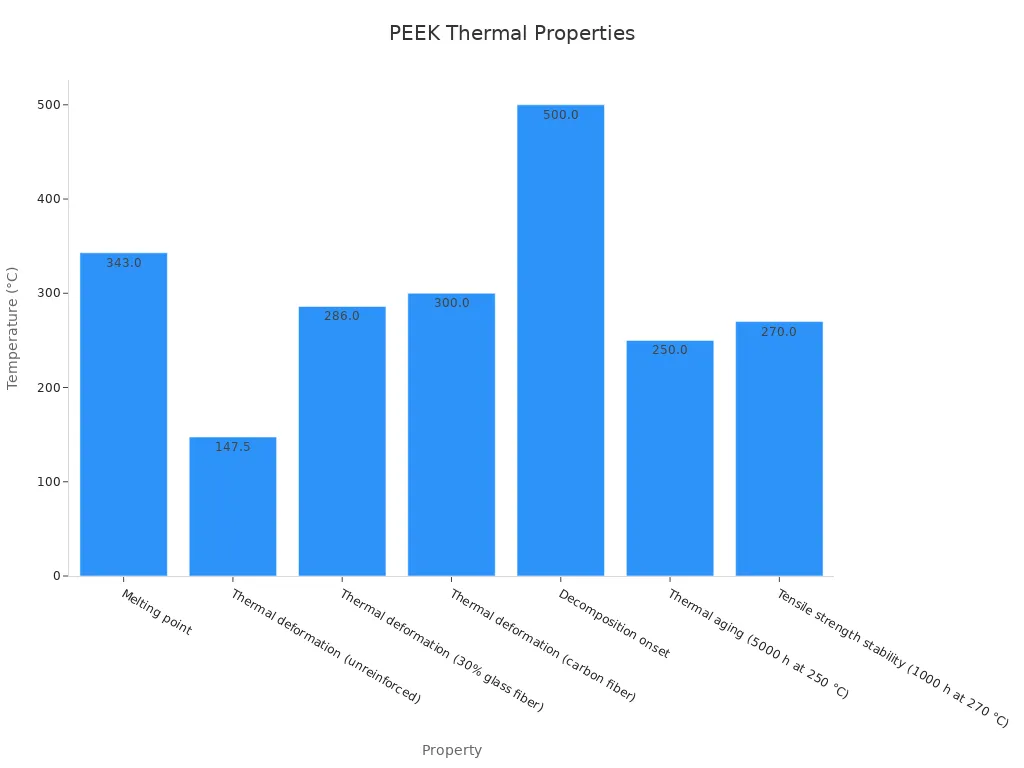
A supplier who really knows PEEK can talk about its properties with real numbers, not just catchy phrases. PEEK keeps working at 250–260 °C, about 30–60 °C hotter than PPS. It melts at 343 °C, and adding reinforcement raises the heat-deflection point: 135–160 °C for plain PEEK, 286 °C for 30% glass fiber grades, and 300 °C for carbon fiber grades. It starts to break down near 500 °C. Glass fiber reinforced PEEK still holds more than 50% of its bending strength after 5000 hours at 250 °C.
Chemical resistance needs just as much attention. PEEK stands up to almost any chemical except concentrated sulfuric acid, and it works well at high heat. A supplier should also spell out the limits. Concentrated sulfuric acid and DMSO can damage the material, and PEEK that is not fully crystallized may stress-crack in solvents like acetone. Annealing or adjusted injection settings raise crystallinity and lower that risk. Dimensional stability completes the picture. Buyers should get clear advice on which grade fits a given temperature, chemical, and load. Different grades fit different jobs, and a strong supplier matches the grade to the work.
Engineering and Machining Support
Machining PEEK goes better with hands-on advice. Feed rate is the tricky variable. Too low and friction builds heat, while too high risks cracking. A supplier should share starting parameters and explain why they work. Typical turning feeds run 0.004–0.025 IPR for unfilled grades and 0.004–0.012 IPR for reinforced grades. Drilling feeds range from 0.007 IPR at 1/16" to 0.020 IPR at 3/4" and above.
Chip appearance gives a simple clue. Short, broken, light-colored chips mean the settings are dialed in. Long stringy chips mean the feed rate is too low or the tool is dull. Dark or burnt chips warn of heat damage that can weaken the part. Suppliers should also suggest finishing passes with a light cut depth and slow feed to reduce tool marks. Support levels differ, so buyers should confirm how much engineering help each supplier offers.
Supply Stability and Capacity

Stable supply starts with one fact about the material. PEEK keeps its molecular structure through repeated heating cycles. It can be reprocessed without losing its core performance. A good supplier should explain this clearly. That answer shows the supplier understands why regrind and reprocessing choices affect part consistency. Buyers who get a confident, accurate answer learn early that the supplier has real technical depth.
Evaluating PEEK Manufacturers' Capacity
Capacity numbers on paper tell only part of the story. PEEK polymerization runs in a high-temperature system where viscosity rises fast. Mixing, heat transfer, devolatilization, and solvent uniformity all become hard to control. Success in the lab does not promise reliable factory scale-up. One good batch does not mean the next batches stay in the same performance window. Capacity does not equal high-end supply capability. The real question is not whether a grade can be made. It is whether a grade that meets customer validation requirements can be made consistently. Buyers should check for long-term, traceable, repeatable production. They should not accept capacity numbers or a first-time success as proof.
A structured capacity review follows a clear order:
State the application and set measurable criteria for functional performance.
Require evidence of quality repeatability, since one good sample proves little about batch-level production.
Request traceability, inspection records, change-control processes, and rules for handling nonconforming output.
Ask for sample testing, relevant references, manufacturing information, and lead-time commitments.
Audit actual process controls on site, which shows more than promotional claims.
Compare total ownership cost and the supplier's response plan for delivery or specification deviations.
Record unresolved risks and assign owners for follow-up to reach a defensible decision.
Lead Times and Inventory Planning
Lead-time commitments deserve the same scrutiny as quality records. Serious PEEK manufacturers quote timelines in writing. They explain what drives them, from raw material scheduling to conversion steps. Buyers should ask how much safety stock the supplier holds. They should also ask which grades sit in inventory versus build-to-order. Regional stocking options help with urgent or repeat-use materials. They also shorten response time when a disruption hits.
Contingency planning separates resilient suppliers from reactive ones. A strong plan identifies which materials are most critical to production. It reviews where those materials are produced, stocked, and converted. It also creates approved alternates where possible. Supply chain transparency matters here. Manufacturers that invest in digital platforms for visibility and after-sales support give buyers earlier warning of trouble. Supplier partnerships and localized production further reduce import dependency and speed recovery. Responsiveness counts too. Fast quoting, cutting material to size, and prompt documentation reduce friction across purchasing, engineering, and operations. Buyers should also factor lead time, freight, tariffs, and downtime into total material cost, not price alone.
Compliance and Traceability
Industry-Specific Compliance
Compliance rules come from the job the material does, not from a general checklist. An oil and gas buyer needs proof that a grade works in downhole conditions, where heat and harsh fluids mix. A medical buyer needs papers that support biological evaluation and resin compliance for devices that touch the body. An aerospace buyer needs records that meet aerospace quality and material specs. Each industry sets its own acceptance rules, and the supplier must show how its material and paperwork meet them.
Buyers should name the end use in the first talk. A strong PEEK manufacturers reply links the grade to the industry's needs and lists the backup documents. A weak reply offers a brochure and a promise. The buyer should ask which standards the material is tested against and who did the testing. Third-party test reports count for more than in-house summaries. Compliance also covers change control. The supplier should promise in writing to tell buyers before any formula or process change that could affect performance.
Documentation and Lot Traceability
Traceability links a finished part back to where it started. A full chain runs from raw material receipt through polymerization, compounding, and conversion to finished resin or stock shape. Each step should carry a lot or batch ID. That ID lets the buyer pull the production record, the test results, and the shipping history for any shipment.
Buyers should test this chain during evaluation. Pick one delivered lot and ask the supplier to trace it back to the raw material. A supplier with a real system answers fast and fully. A supplier without one gives gaps or vague assurances. The document package should also include certificates of analysis, material certifications, and inspection records. Reliable PEEK manufacturers treat these records as normal output, not special requests. Buyers who check the traceability chain before placing volume orders protect themselves from costly recalls and disputes later.
Cost and Value
Total Cost of Ownership
The price per pound is only a small piece of the cost picture. Downtime, scrap, rework, and qualification costs usually add up to much more than the resin price. PEEK's wear resistance and dimensional stability make parts last 3–10x longer than PTFE dynamic parts. That longer life means less equipment downtime, fewer replacement parts in stock, and lower maintenance labor costs.
A cost comparison shows which grade fits best in each case.
Cost element | Under-spec (cheaper grade) | Right-spec (correct grade) |
|---|---|---|
Resin / blank cost | Lowest | +10–40% |
Machining & tooling | Standard | Standard to +20% |
Field failure & downtime | High and likely | Near zero |
Re-qualification | Often required | Avoided |
Total cost of ownership | Highest | Lowest |
The table teaches a clear lesson. A wrong spec pushes total cost of ownership to its highest point, even when the resin price looks lowest.
Design choices change cost too. PEEK's longer service life, lower maintenance, weight savings, and heat resistance up to 250°C all support the same performance-to-cost case.
Weighing Price Against Reliability
A low quote deserves a close look at what it leaves out. Buyers should compare suppliers on the full cost picture: resin price, machining and tooling, expected field failures, and re-qualification risk. A supplier who offers multiple material options can match each application to the grade that fits it best. Super Dragon's broad advanced polymer portfolio covers engineering, automotive, electronic, and other material families, so buyers can weigh each option on its own merits. No single material wins every case. The right grade for a high-wear assembly may differ from the right grade for a housing or an insulating part.
Reliability earns its place in the decision. A supplier with stable quality and documented lot data protects the buyer from scrap spikes and line stoppages. Those events cost far more than a modest price difference. Buyers should treat price as one input among several and let evidence from the other four pillars carry the final call.
The five pillars work together as one system. Quality, expertise, supply stability, compliance, and value all support each other. A buyer who checks them together sees the full picture.
A short checklist helps with any supplier audit or RFQ review:
Confirm what the certification covers and get lot-level certificates of analysis.
Test the traceability chain on one delivered lot.
Ask for written lead times and details about safety stock.
Request samples, references, and total cost of ownership data.
Evidence should guide the decision, not price alone. Buyers who ask for documentation, samples, and references build lasting partnerships with dependable PEEK manufacturers.
FAQ
Which certification should a buyer check first?
ISO 9001:2015 is the starting point. Industry rules add more: AS9100D for aerospace, and ISO 10993-1 and 21 CFR 177.2415 for medical work. Buyers should make sure the certificate scope covers the real production site, not just the company name.
How can a buyer verify batch consistency?
Ask for a certificate of analysis for each lot. A good CoA lists the test method, the specification limit, and the measured result. Lot-specific data is always better than a generic datasheet. Data from several lots shows whether the process stays centered.
What lead-time details should a supplier provide?
Serious manufacturers put timelines in writing and explain what drives them. Buyers should ask how much safety stock the supplier holds, which grades are in stock versus build-to-order, and how the supplier plans for disruptions.
Why does lot traceability matter?
A full chain runs from raw material receipt through polymerization, compounding, and conversion to finished resin or stock shape. Each step should carry a lot ID. Buyers can test the system by asking the supplier to trace one delivered lot back to its raw material.
Does a lower price per pound save money?
Rarely. Downtime, scrap, rework, and qualification costs usually outweigh the resin price. PEEK parts often outlast PTFE dynamic parts by 3–10x, which cuts maintenance and replacement costs. Buyers should compare total cost of ownership, not price alone.