

Picking the wrong supplier costs you real money. Thermal testing fails late in the program. Qualification gets pushed back by weeks. Production lines sit idle while teams look for replacement material. Each problem comes back to the same root cause: claims from a supplier that were never checked.
Reliability comes down to five evaluation steps plus a check of the supplier landscape. Teams that follow this sequence catch weak candidates early and protect their schedules.
This framework is practical and repeatable. Readers can use it on any shortlist of thermally conductive plastics suppliers, from first inquiry to final qualification.
Key Takeaways
Make a clear list of what you need before you talk to any supplier.
Make sure the supplier has up-to-date certificates for the exact grade.
Consider the overall cost, not just the price per kilogram.
Understand the supplier market and pick the right source.
Use a checklist to compare suppliers, and ask for samples early.
Step 1: Define Technical Criteria
A shortlist is useless without a written specification. Buyers should turn the application into measurable requirements before they contact any supplier. This document becomes the measuring stick for every sample and every data sheet that follows.
Thermal and Electrical Properties
Thermal conductivity sets the baseline. The specification should state the required through-plane or in-plane value, the expected heat load, and the operating temperature range. A material that works well in one direction may fail in another. So the test direction matters as much as the number itself.
Electrical behavior deserves equal attention. Many electronics housings need electrical insulation as well as heat transfer. The specification should define dielectric strength, volume resistivity, and any flame-retardant requirement the end product must meet. Buyers who skip this step often find a conductive filler that fixes the thermal problem but breaks the electrical one.
Mechanical and Processing Needs
Mechanical requirements protect the part through its service life. The specification should capture tensile strength, impact resistance, and dimensional stability under thermal cycling. A thin wearable housing and a laptop chassis carry very different mechanical loads. So the criteria must match the actual part geometry.
Processing needs complete the picture. The chosen resin must run on the intended equipment, whether that is injection molding, extrusion, or another method. Buyers should record the target wall thickness, cycle time expectations, and tooling constraints. A material that meets every thermal target but cannot fill a thin wall at production speed will stall the program just as surely as a failed thermal test.
Step 2: Match Application Fit
A data sheet shows how a material acts under set conditions. The real use rarely matches those conditions. Buyers must make sure the candidate material can handle the actual setting. They also need to know the supplier can support the design cycle.
Environment and Reliability Testing
Every electronics product faces its own set of stressors. A smart wearable meets sweat, skin oils, and repeated bending. A laptop chassis takes heat cycling from parts inside it. A mobile phone housing gets drop impact and daily handling. Buyers should list these stressors and ask each supplier for test data that speaks to them directly.
Reliability testing shows how a material acts over time. Suppliers should give results from thermal cycling, damp heat exposure, and mechanical fatigue where it applies. Buyers should compare the test conditions with their own operating range. A material that passes a mild aging test tells the team little about how it performs in a harsher setting. Suppliers who cannot give relevant aging data bring in risk that shows up later in qualification.
Design and Prototyping Support
Good suppliers add engineering help, not just pellets. Buyers should ask if the supplier offers mold-flow analysis, gate placement advice, or processing guidance for the exact resin grade. These services cut the learning curve and lower scrap during the first production runs.
Prototyping support is what sets responsive suppliers apart from catalog vendors. The shortlist should include suppliers who send sample quantities fast and who answer processing questions during the trial. Buyers should make sure the sample grade matches the production grade. A trial built on a different formulation proves nothing about the final part. Suppliers who get involved early with tooling and cycle-time questions tend to make qualifications go smoother. That early involvement also shows how the relationship will go after the purchase order.
Step 3: Verify Regulatory Compliance
Standards and Certifications
Compliance failures stop a program fast. A material without the right certification cannot enter the qualification pipeline, even if it performs well in the lab. Buyers should list every standard the end product must meet before they evaluate any candidate. Common requirements include UL 94 flame ratings for the housing, RoHS and REACH restrictions for material content, and IEC safety standards for the finished device. Each market adds its own rules, so the list should cover every region where the product will ship.
Buyers should then ask each supplier for current certificates, not marketing summaries. A certificate names the exact grade, the standard, and the issuing body. The grade on the certificate must match the grade on the data sheet and the grade in the sample box. Suppliers who cannot produce a certificate for the specific grade raise a red flag. Teams should also check that certificates are still valid and cover the latest revision of the standard.
Documentation and Traceability
Paperwork proves what a supplier claims. A reliable supplier keeps a documentation package for each grade. That package usually includes the technical data sheet, safety data sheets, compliance declarations, and test reports from recognized laboratories. Buyers should request the full package during evaluation, not after the purchase order. Reviewing documents early exposes gaps while the shortlist is still open.
Traceability closes the loop between the sample and the shipped lot. Buyers should confirm that the supplier can link each production batch to its material records, test results, and date of manufacture. Lot-level traceability matters most when a qualification test fails. The team can then isolate the affected batch instead of quarantining an entire inventory. Suppliers who track batches well also respond faster to quality questions. That speed protects schedules when problems appear.
Step 4: Evaluate Total Cost
Cost-of-Ownership Factors
The price per kilogram is only one part of the story. Buyers should build a cost model that covers the whole life of the part. Scrap rate belongs in that model. A resin that fills thin walls well makes fewer rejects, and fewer rejects lower the real cost per good part. Cycle time matters too. A grade that needs more cooling time cuts output on every shift.
Qualification cost needs its own line. Each candidate material uses up engineering hours, test coupons, and lab time. A cheaper grade that fails thermal cycling makes the team start over with a new candidate. Buyers should also count tooling wear, because abrasive fillers can shorten mold life. Freight, minimum order quantities, and inventory carrying cost finish the picture. A supplier with a low unit price but a big minimum order can tie up cash the program needs elsewhere.
Pricing and Supply Stability
Stable pricing protects the program budget. Buyers should ask how each supplier sets prices and how often those prices change. A supplier who ties pricing to a published index gives the team a steady basis for planning. Buyers should also ask about allocation policy when markets are tight. A supplier who saves capacity for qualified customers keeps the line running when demand spikes.
Supply stability goes beyond price. Buyers should confirm where each grade is compounded and whether a second site can make it. Single-site supply creates a single point of failure. Lead time claims need checking against real order history, not just a quoted number. Buyers can ask for on-time delivery records for the past year. How a supplier responds during a shortage separates reliable partners from catalog vendors. A supplier who flags a supply risk early gives the team time to qualify an alternate. That early warning often saves more money than a small discount on the invoice.
Step 5: Know Thermally Conductive Plastics Suppliers

A strong shortlist starts with a clear view of the market. The thermally conductive plastics market is somewhat concentrated among compound suppliers. A few large firms hold most of the capacity, and each one brings a different strength to a program. Buyers who map the landscape before they send inquiries save weeks of back-and-forth later.
Major Compound Suppliers
Celanese offers the CoolPoly line, a family of specialty compounds built around thermal management. Teams often look here when they need a focused portfolio and deep application data. Covestro brings Makrolon TC grades, which build on its polycarbonate base and suit programs that already use that resin family. Avient sells Therma-Tech compounds and pairs them with color and additive services, a fit for teams that want formulation flexibility. SABIC offers LNP KONDUIT grades within a broad engineering-resin portfolio, which helps buyers who source several materials from one partner.
BASF and RTP Company both carry wide portfolios that span many resin systems. Buyers who need one supplier across multiple parts often start with these broad-portfolio options. 3M and AGC bring strong materials-science backgrounds and suit programs that value deep technical support. Arkema fits teams working with high-performance polymers. Polysesle Electronic and Electrical Materials is another option for electronics work. The line targets smart wearables, laptop computers, and mobile phones, and it combines electrical insulation, thermal stability, and mechanical strength for sensitive components. Each of these suppliers fits a different program profile. No single one is best for every application.
Distributors vs. Direct Manufacturers
The next decision is the channel. Buyers can source thermally conductive plastics through a distributor or straight from the compound manufacturer. Each route has trade-offs, and the right choice depends on order size, technical needs, and how much support the team requires.
Factor | Distributor | Direct Manufacturer |
|---|---|---|
Order size | Smaller quantities, mixed orders | Larger volumes, full production lots |
Technical support | General product knowledge | Formulation and processing experts |
Lead time | Stock items ship fast | Tied to production scheduling |
Custom grades | Limited | Full formulation access |
Distributors work well for prototyping and for teams that need several materials in small amounts. They hold stock and shorten the path to a first sample. Direct manufacturers take over when a program moves to production. They control the formulation, so they can adjust a grade for a specific part or resolve a processing problem at the source. Many buyers use both routes: a distributor for early trials, then the manufacturer for scale-up. The key is to confirm that the distributor sources from an authorized channel. Gray-market material carries no traceability and no warranty. Buyers should also check whether the distributor can pull in the manufacturer's engineers when a technical question goes beyond the catalog.
Step 6: Use a Supplier Checklist
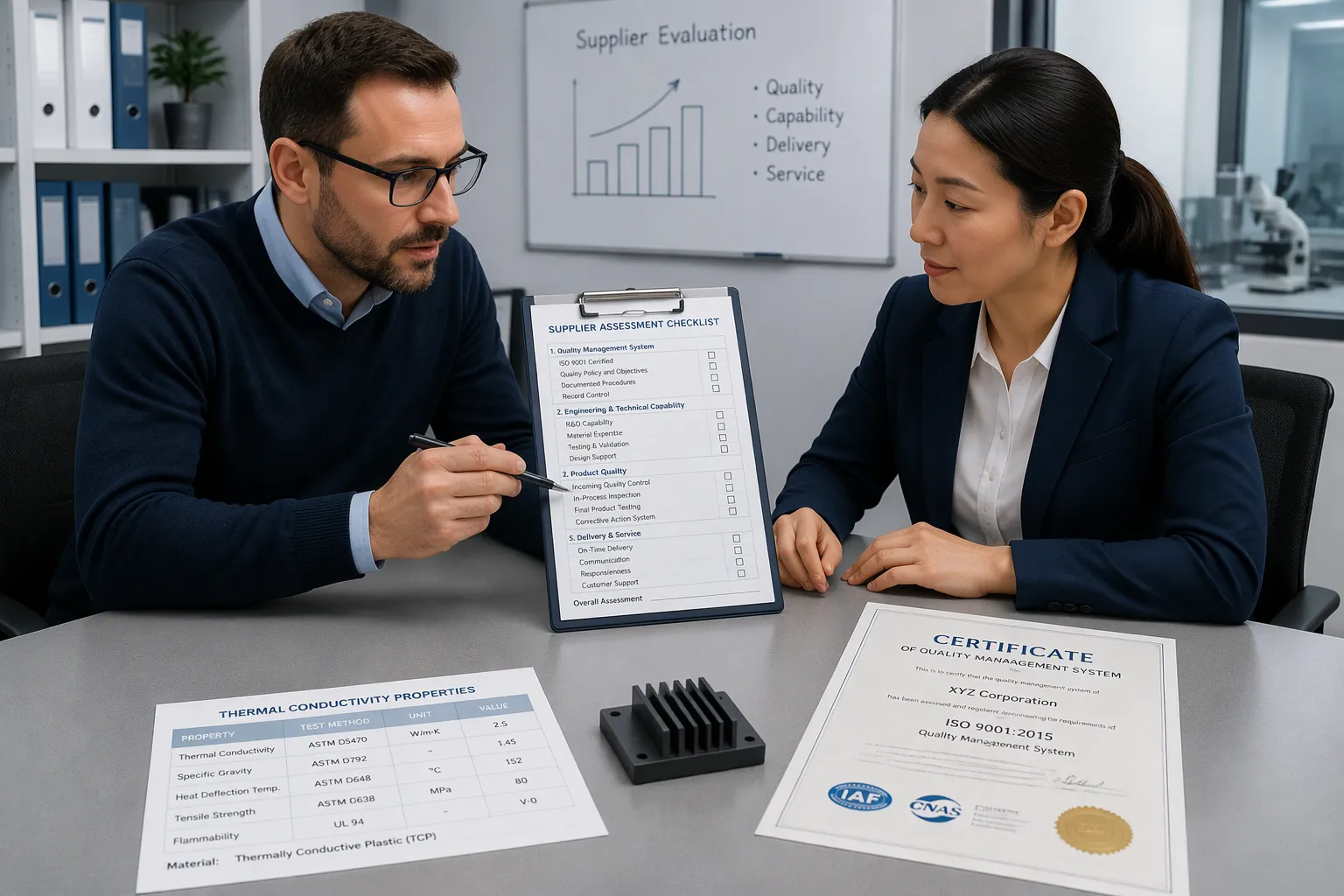
A shortlist means little without a steady way to score it. A written checklist turns scattered impressions into answers you can compare. Buyers can ask every candidate the same questions and spot the gaps fast.
Capability and Quality Questions
The first pass covers what the supplier can really do. Buyers should ask which resin systems the supplier compounds and which thermal conductivity ranges it covers. They should also ask whether it offers grades with electrical insulation. They should confirm the supplier's quality system and ask for recent test reports from recognized laboratories.
A short checklist keeps the review focused:
Question | What a strong answer looks like |
|---|---|
Which grades match our spec? | Named grades with data sheets |
Is the quality system certified? | Current certificate for the site |
Can the supplier share aging data? | Test reports tied to our stressors |
Who handles technical questions? | A named engineer, not a call center |
Buyers should score each answer against the written specification from Step 1. A supplier who cannot name a matching grade or show a current certificate moves to the bottom of the list.
Samples, Lead Times, Responsiveness
Samples prove more than a data sheet can. Buyers should request the exact production grade and confirm the sample matches it. They should also time the response. A supplier who ships samples quickly and answers processing questions during the trial shows how the relationship will run after the order.
Lead times need checking against real history, not a quoted number. Buyers should ask for on-time delivery records and confirm whether a second site can make the grade. Responsiveness matters most when a problem appears. A supplier who flags a supply risk early gives the team room to qualify an alternate. That habit separates reliable thermally conductive plastics partners from catalog vendors. Using this checklist on every candidate keeps the final choice based on evidence.
The six steps give teams a path they can repeat. Buyers define specs, confirm application fit, verify compliance, assess total cost, scan the supplier landscape, and run the checklist. Each step removes a source of risk before the next one begins.
Reliability shows up in documents, samples, and fast answers. Marketing claims prove nothing on their own. A supplier who ships the exact grade and shares current certificates earns trust through evidence.
Teams should apply the checklist to their current shortlist of thermally conductive plastics suppliers today. Request samples and compliance documents before signing anything. That single move turns a hopeful pick into a verified one.
FAQ
How many suppliers should a team shortlist?
A shortlist of three to five candidates gives the team room to compare. Fewer options limit leverage and backup plans. More options spread engineering time too thin. Each candidate needs a full document review and a sample trial, so the list should stay small enough to evaluate properly.
Can a distributor serve as the primary source?
A distributor works well for prototypes and small mixed orders. Production programs usually need the compound manufacturer directly. Buyers should confirm the distributor sources through an authorized channel. Gray-market material carries no traceability and no warranty. Many teams use both routes and shift to the manufacturer at scale-up.
Which documents should a buyer request first?
Start with the technical data sheet, the safety data sheet, and current compliance certificates for the exact grade. Add test reports from recognized laboratories and the supplier's quality system certificate. Reviewing this package early exposes gaps while the shortlist is still open, before engineering hours go into sampling.
What should a team do when a sample fails testing?
A failed sample is useful data. The team should share the test conditions and results with the supplier and ask for a formulation review. A supplier who responds with a revised grade or processing advice shows real support. A supplier who deflects the question belongs lower on the list.
Does a higher price per kilogram mean better quality?
Not on its own. Price reflects formulation, volume, and channel, not reliability. Buyers should weigh scrap rate, cycle time, qualification cost, and supply stability alongside the unit price. A grade that fills thin walls cleanly often costs less per good part than a cheaper resin with high rejects.