

How do you find a manufacturer of engineering plastics that offers real custom mixing instead of standard catalog compounds? The answer is to search in a careful, step-by-step way. First, you define what your application needs. Then you research possible suppliers, check their technical skills, and review their regulatory compliance. After that, you compare costs, ask for samples and test them, and pick the partner who fits best.
This guide is for engineers and purchasing professionals who need practical, usable criteria. Each step gives you specific questions to ask and proof to request. That way, your final choice rests on proven ability rather than guesswork.
Key Takeaways
State your application needs clearly to set a standard for judging suppliers.
Check how skilled a manufacturer is at technical work and custom mixing.
Check the rules to make sure you are in compliance, and ask for the certifications and documents you need.
Look at the total cost of ownership, not just the unit price, to find the best value.
Try the samples on your own machines before you choose a supplier.
Define Application Requirements
Performance and Operating Conditions
Begin with the physical demands your part will face. List the highest and lowest temperatures it must handle, the loads it must carry, and any chemicals it will touch. Note whether the part needs electrical insulation, flame resistance, or wear resistance. A bracket for an engine bay and a housing for a medical device need very different polymer grades.
Write these conditions down as a specification sheet. Include the test methods you will use to check each property. This sheet becomes the benchmark for every candidate you evaluate later. Vague requirements invite vague proposals. Precise requirements let a formulator show exactly how their compound meets your needs.
Volume, Timeline, and Budget
Estimate your yearly volume and your launch date. Custom formulators need this information to plan lab trials and production runs. A small first order may work for a pilot program. A large repeat order justifies deeper development work. State both figures clearly.
Set a realistic budget range for material, tooling, and testing. Custom formulation carries development costs beyond the resin price. Ask each candidate to list these costs separately. A clear budget helps you compare quotes on equal terms. It also shows suppliers that you understand the development process.
Identify Manufacturers of Engineering Plastics
Directories, Databases, and Trade Shows
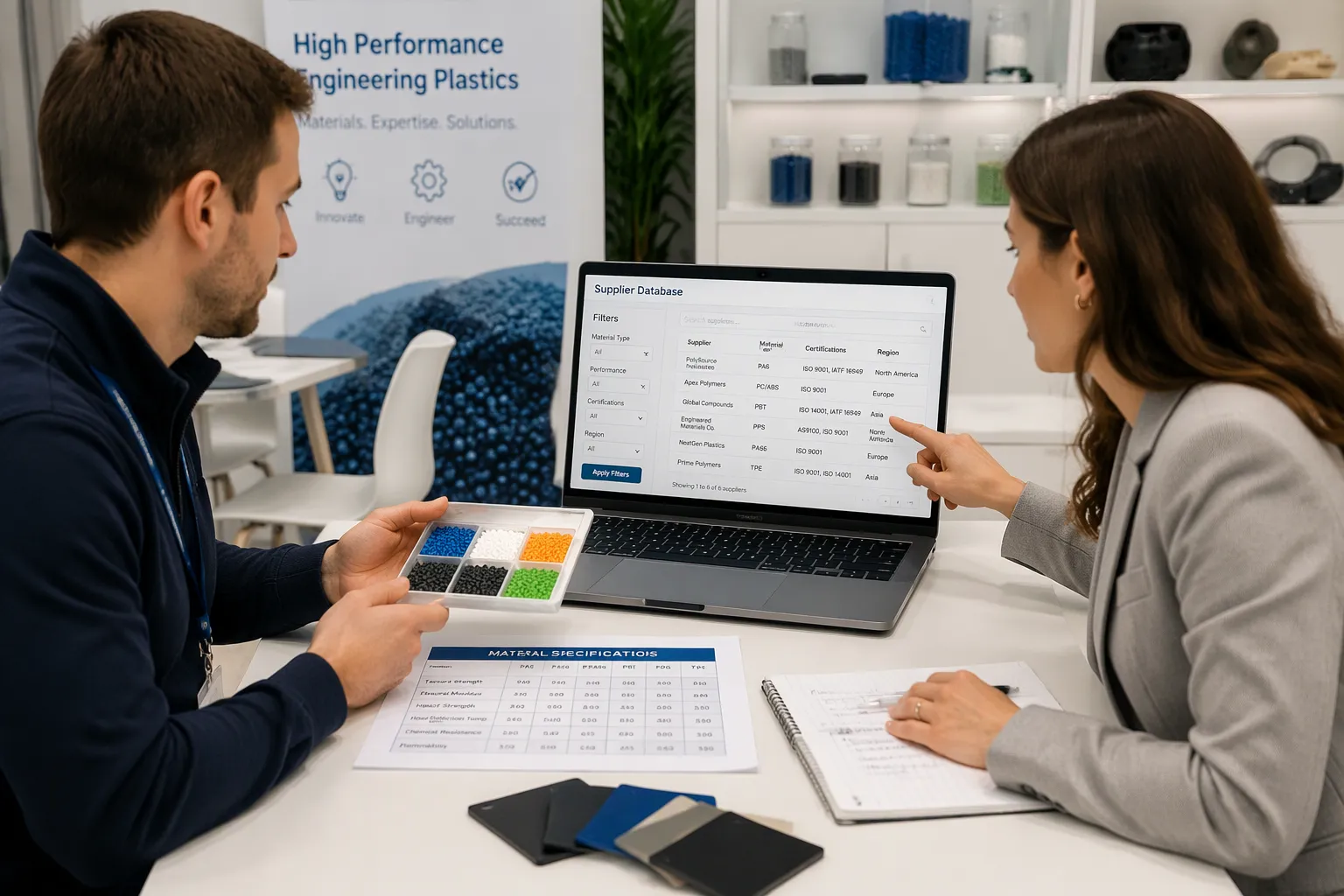
Begin your search with industry directories and company databases. These resources list engineering plastics manufacturers by material type, process, and region. Many databases let you filter for suppliers that offer custom compounding instead of catalog-only grades. Put U.S.-based suppliers in your first pass, even if you plan to source elsewhere. A wide first list gives you more candidates to check against your specification sheet.
Trade shows give you something a database cannot: a direct talk. Walk the floor and ask each exhibitor one question. Can they build a formulation from your performance targets, or do they only sell existing grades? The answer tells a true formulator apart from a distributor. Material supplier referrals work the same way. Resin producers often know which compounders handle specialty work well. Ask their technical representatives for names.
Keep your notes neutral at this stage. Write down what each candidate claims and what evidence they offer. Do not rank suppliers yet. Your goal is a working list of ten to twenty names, drawn from several sources. A manufacturer of engineering plastics may appear in one directory and not another, so cross-check your results.
Referrals and Supplier Networks
Your own network can make the search much shorter. Ask colleagues in engineering and purchasing which formulators they trust. A peer who has run a custom compound through production knows more than any brochure. Ask specific questions. Did the supplier hit the color target on the first trial? Did they flag a processing issue before it became a problem? Did they deliver on schedule?
Industry associations and technical societies also link buyers with formulators. Local manufacturing groups often keep member lists with capability descriptions. Equipment makers are another useful channel. A twin-screw extruder builder sees which compounders invest in real development capacity. Their sales engineers can point you toward active formulators.
Treat every referral as a lead, not a verdict. A supplier that served one application well may lack experience in your sector. Check each name against your requirements before you spend time on evaluation. Build a simple tracking sheet with columns for source, contact, claimed capabilities, and next action. This record keeps your search organized and shows your team how each candidate entered the pipeline.
A good manufacturer of engineering plastics will welcome detailed questions about formulation experience. Suppliers who hesitate at this stage rarely improve later. Move the strongest candidates forward to the technical evaluation, where you will test their claims against real evidence.
Evaluate Technical Capabilities
Formulation and Compounding Expertise
Ask each candidate to explain a recent custom project from beginning to end. You want to hear how they turned a performance goal into a formulation. Strong formulators describe their base resin choice, additive package, and the trials they ran to close the gap. They also explain what failed along the way. A supplier who says every trial worked on the first try either got lucky or is not telling you the whole story.
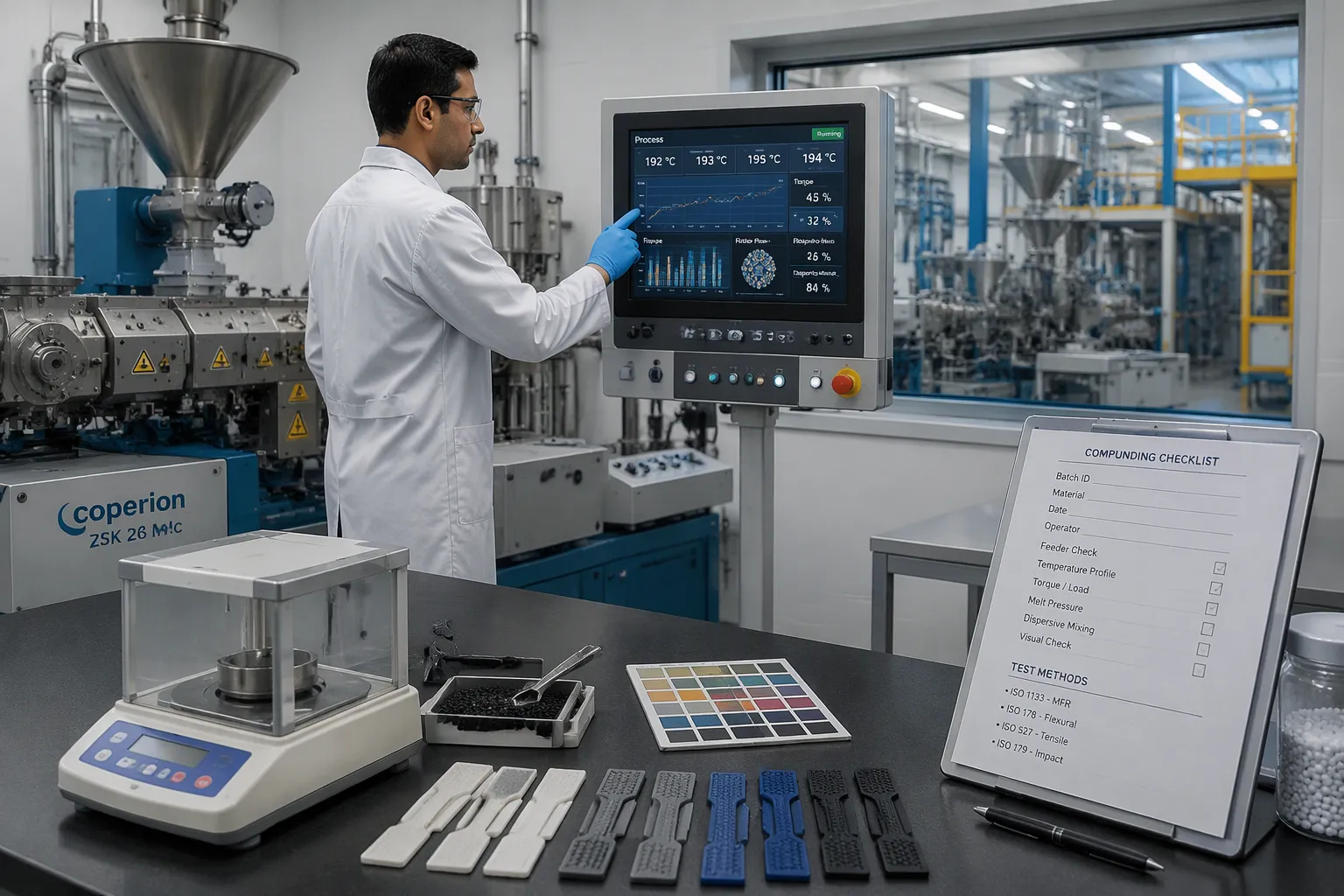
Custom compounding is the next skill to check. Ask what equipment the plant runs and how they control dispersion and melt temperature during the run. Good mixing shows up in consistent mechanical properties across the batch. Poor mixing shows up as weak spots, color streaks, and lot-to-lot variation. Request a plant tour or a video walkthrough of the compounding line. Seeing the equipment tells you more than any capability brochure.
Color matching deserves its own check. Send a physical color target, not just a code. Ask how many trial rounds the supplier usually needs and how they handle metamerism, where two colors match under one light source and diverge under another. A capable manufacturer of engineering plastics will discuss pigment selection and light-source testing without prompting.
Scale-up separates real compounders from lab-only shops. A formulation that works in a gram-scale mixer can act very differently in a production extruder. Ask how the supplier moves from lab sample to pilot run to commercial volume. Request evidence that they have scaled a similar formulation before. Confirm they will run a pilot batch before committing to full production.
Testing, Quality Control, and Support
Ask which tests the supplier runs in-house and which they send out. In-house mechanical, thermal, and rheological testing shortens development cycles. It also lets the supplier catch problems before material ships. Request the actual test methods they use, not just the property names. A certificate that lists a value without a method is hard to verify.
Review their quality control plan for incoming resin, in-process checks, and final batch release. Ask how they retain samples and for how long. Traceability matters when a field failure appears months after delivery. A supplier with solid records can trace a batch back to its raw materials quickly.
Technical support shapes the whole relationship. Ask who your engineering contact will be and how fast they respond to questions. Confirm whether they offer processing guidance for your specific equipment. A formulator who understands your molding or extrusion process will flag issues before they cost you a production run.
Finally, ask for two or three customer references in applications similar to yours. Call those references and ask about response time, batch consistency, and how the supplier handled a problem. Their answers will tell you whether the technical capability on paper holds up in daily practice.
Assess Regulatory Compliance
Certifications and Documentation
Start by looking at the quality management system. ISO 9001 certification gives you a basic sign of quality. It shows the supplier follows written processes, tracks fixes, and gets checked by outside auditors. Ask for the current certificate and read the scope statement. A certificate that covers compounding but not warehousing shows you where the audit stops. Check the expiry date and who issued the certificate.
Material documents matter just as much. Ask for a technical data sheet and a safety data sheet for every grade you discuss. Ask if the supplier can provide a declaration of conformity and batch-level certificates of analysis. For regulated markets, ask about substance declarations for RoHS and REACH. A formulator who produces these documents quickly and correctly has done this work many times. Slow or incomplete paperwork points to a weak compliance process.
Sector-Specific Requirements
Each industry has its own rules, and you should list them before you make a shortlist. Medical device work often needs ISO 13485 systems and careful change control. Automotive programs usually expect IATF 16949 alignment and production part approval processes. Electronics applications may need UL recognition of the compound and compliance with solder reflow conditions. Construction and appliance parts bring their own flame and smoke performance demands.
Do not assume a supplier's general certification covers your sector. Ask directly which sector-specific approvals they hold and which they do not have. Request the actual certificates, not a summary. Then confirm the approval applies to the exact grade you plan to buy. A plant-level certificate does not always cover a new formulation. Add this evidence to your evaluation file, and treat missing documents as an open item to fix before you commit.
Compare Cost Structures
Unit Price vs. Total Cost of Ownership
A low unit price can hide real costs. Look past the per-kilogram quote and add up every cost your part will carry. Scrap rate, regrind allowance, cycle time, and reject rate all change the true cost of a compound. A material that molds faster or yields fewer rejects often beats a cheaper grade on the bottom line.
Build a simple comparison for each finalist. List the unit price, the expected scrap rate, and the processing adjustments the supplier recommends. Ask each supplier to put their assumed scrap rate in writing. Then figure out cost per good part by dividing unit price by the share of good parts. This one number lets you compare every quote fairly.
Cost item | What to ask | Why it matters |
|---|---|---|
Unit price | Price per kg at your volume | Sets the starting point |
Scrap and regrind | Expected reject rate, regrind limits | Raises the real cost per good part |
Processing | Recommended cycle and drying profile | Affects machine time and energy |
Freight and packaging | Shipping terms, package size | Adds to the delivered cost |
Tooling, MOQ, and Lead Time
Custom formulation rarely needs new molds, but it may need new tooling for test bars, color chips, or trial runs. Ask each supplier to list these charges one by one. Some build development work into the unit price at higher volumes. Others bill it upfront. Compare the total over the life of your expected orders, not just the first purchase.
Minimum order quantity affects your cash flow and inventory risk. A high MOQ lowers unit price but ties up money in stock you may not use for months. Ask if the supplier offers a smaller pilot quantity before the full run. Confirm the lead time for that pilot separately from the commercial lead time.
Lead time should be a written promise. Ask for the standard lead time and the lead time during peak demand. Request a backup plan for repeat orders. A supplier who quotes a short lead time without explaining capacity may miss it when busy. Weigh price against reliability, and treat a realistic schedule as part of the cost.
Request and Test Samples
What to Specify in a Sample Request
A sample request is a short engineering plan, not a quick email. State the grade or formulation you want checked, the color target, and the processing method you will use. Name the test methods you plan to run, like tensile testing or heat deflection temperature measurement. Give the amount you need for trials plus saved specimens. Ask for a certificate of analysis with the shipment.
Include your operating conditions in the request. List the temperature range, chemical exposure, and load profile the part will face. A formulator can then adjust the additive package before the trial run instead of after a failure. Ask how the supplier will label each sample. Batch identification matters when you compare results across two or three candidates.
Set a delivery date and confirm it in writing. Ask whether the sample comes from a lab batch or a pilot line. Lab material proves the formulation works. Pilot material proves the process works. Request pilot material whenever your volume justifies it.
Validate Against Your Criteria
Test every sample against the specification sheet you wrote in step one. Run the same methods on every candidate so the results compare directly. Record raw data, not just pass or fail marks. A compound that misses one target slightly may still win on processing or cost.
What to check | Evidence to demand |
|---|---|
Mechanical and thermal properties | Test reports using your named methods |
Color match | Physical chips under your plant lighting |
Processing behavior | Trial run notes on your equipment |
Batch consistency | Data from more than one lot |
Run a trial on your own machine before you commit. Watch for warpage, short shots, or inconsistent color. Ask the supplier to review your trial notes and propose fixes. A formulator who responds with specific adjustments has the expertise you need. Compare all results on one scorecard, then move the strongest candidate to final selection.
Select the Right Manufacturer of Engineering Plastics
Scorecard for Comparing Finalists
Turn your evaluation notes into one weighted scorecard. List the criteria you have already tested: requirement fit, formulation expertise, testing and quality control, compliance documents, total cost, and sample results. Give each criterion a weight that matches your project. A medical program should weight compliance and change control heavily. A high-volume industrial part should weight cost per good part and lead time.
Score each finalist on the same scale, then multiply the score by the weight. Keep the raw evidence next to every score, so the ranking rests on documents and test data rather than impressions. Review the results with your team before you decide. A supplier who leads on price but trails on sample consistency may still win, as long as you understand the trade-off. The scorecard makes that trade-off visible.
Contract Terms and Supply Continuity
Put the agreed formulation, color target, test methods, and acceptance limits in writing. Name the exact grade and revision in the contract. Add a change-control clause. The supplier must notify you before changing a resin source, additive, or process step, and you must approve the change before shipment. This clause protects the performance you validated in your trials.
Plan for continuity of supply. Ask how the supplier holds raw material stock and what notice they need for volume changes. Confirm the lead time for repeat orders and the escalation path when demand spikes. Request a second production site or a qualified backup compounder for critical parts. A capable manufacturer of engineering plastics will discuss these arrangements openly and put them in the agreement.
Set review points after launch. Meet quarterly to review batch data, complaints, and forecast changes. A long development relationship with your chosen formulator pays off in faster problem solving and steadier quality over the life of the part.
You now have a clear path: define requirements, identify candidates, evaluate technical capability, assess compliance, compare costs, test samples, and select. Two stages matter most. Requirements definition sets the benchmark for every comparison. Sample validation proves the claims on your own equipment.
Weigh the full picture, not the lowest quote. A structured scorecard shows where each finalist fits best and keeps the decision grounded in evidence.
Once you choose a manufacturer of engineering plastics, treat the contract as the start of a development partnership. Share trial data, review batch results together, and plan for supply continuity. That relationship turns a capable formulator into a long-term advantage.
FAQ
How do you confirm a supplier truly offers custom formulation?
Ask them to explain a recent project from start to finish, from the performance goal to the final compound. Pay attention to how they chose the base resin, picked additives, and which trials failed. Ask for pilot-line samples, not just lab batches. A supplier who only sells catalog grades will have a hard time answering these questions with real details.
How long does custom formulation take?
The time it takes depends on how far your targets are from existing grades, how many color-matching rounds are needed, and whether your industry requires new approvals. Ask each candidate for a project timeline with milestones. Treat the pilot batch as the true checkpoint, because it proves both the process and the formulation.
What drives the cost of a custom compound?
Resin choice, the additive package, color complexity, and volume all affect the price. Development and testing fees add to the first order. Compare cost per good part instead of unit price alone. Scrap rate and how the material processes often matter more than the per-kilogram quote.
Can you work with a formulator on a small first order?
Many compounders offer pilot quantities before a full production run. Ask about this option early, and confirm the pilot lead time separately from the commercial lead time. A small trial order lets you test the material on your own equipment before you commit to larger volumes.
How do you protect supply after the contract is signed?
Put the exact grade and revision in the agreement, along with a change-control clause. Ask how the supplier stocks raw materials and how much notice they need for volume changes. For critical parts, qualify a backup source. Reviewing batch data every quarter keeps quality steady over the life of the part.